
The mental model most founders carry about outsourcing SaaS development is about 15 years out of date.
It goes like this: offshore = cheap = junior developers executing tickets in a timezone you can't reach, with code you'll spend the next year fixing. That model existed. Some shops still run it. But it describes a commodity body-shop, not a senior-led engineering team — and conflating the two is why so many founders either overpay for a US agency or get burned by a cheap offshore one without understanding there was a third option they never evaluated.
This article is about what that third option actually delivers: what changes when the offshore team is senior-led, what the quality/timezone/communication objections look like under scrutiny, and three concrete questions to ask before you hire anyone.
What "senior-led" means in practice
A body-shop offshore engagement typically looks like this: a project manager in your timezone, a lead developer you barely speak to, and a roster of mid-to-junior engineers executing specs someone else wrote. The PM is the interface. The engineers are interchangeable. The architecture decisions land with whoever wrote the brief — usually you, often without enough context.
A senior-led offshore team inverts that. The engineers — experienced people who have shipped production SaaS systems before, not juniors executing tickets — own architectural decisions, write the specs, and push back when the brief is wrong. They don't wait to be told what to build. They tell you what they'd build and why, then build it.
The difference is visible in the artifacts. A senior dev's pull request has a description that explains the decision, not just the change. It references the alternative approaches considered. It notes the tradeoff made. When engineers on our team open a PR touching the auth layer or the billing module, the description reads like a short ADR — architecture decision record. That's not a process we enforce with a checklist. It's what happens when the person writing the code has strong enough opinions to articulate them.
The quality objection
The objection usually sounds like: "How do I know the code will be production-quality?"
The honest answer is: you don't know that from geography. You know it from process. And process is something you can evaluate before you sign anything.
Here's what our internal review gate looks like for every PR that goes to client review:
- CI must pass — tests, type-check, lint. Non-negotiable, no overrides.
- PR description must name the approach chosen, the alternative considered, and why.
- A second senior engineer reviews before the client sees it.
The point of that gate isn't perfect code — no process delivers that. It's that the class of defect that causes production incidents gets caught by a second senior reviewer before it reaches you, not after. Most incidents on small SaaS teams don't come from hard problems; they come from an unreviewed edge case shipping on a Friday afternoon. A review gate exists to make that structurally hard to do.
For a founder, that's not an abstract quality argument — it means fewer surprise rewrites, fewer production regressions, and less of your week spent translating business context into technical rescue work.
When you're evaluating an offshore team, ask to see the last three merged PRs. Not the code specifically — the PR descriptions. If they're one-liners ("fixed auth bug", "updated endpoint"), the team isn't operating at senior level regardless of what their proposals say.
The timezone objection
IST is UTC+5
. That's the fact. What people do with it varies.A standard 9am–6pm IST workday overlaps with:
- Central Europe: roughly 3.5–4.5 hours of overlap depending on daylight saving. A 9am–6pm IST day typically covers the European morning and early afternoon.
- US East: little to no overlap in standard working hours, unless both sides intentionally create a late-IST / early-US window.
If you're a US-based founder, the timezone gap is real. But the assumption that "no overlap = broken communication" is wrong — it assumes all meaningful engineering work requires synchronous discussion. Most of it doesn't.
Running async-first means decisions that need input are written down with context and options before any standup. Standup is for confirming, not discovering. US clients get a written brief on every open decision each morning, a summary of what shipped overnight, and one weekly synchronous call — 45 minutes — for anything that genuinely requires back-and-forth.
There's a secondary benefit worth naming: while a US-based team is asleep, we can move staging forward — CI runs, migrations are tested, QA notes are written, and the next build is ready for review by the time your team logs on. For SaaS products where deployment cadence matters, that follow-the-sun pattern is an operational advantage, not a limitation.
The communication objection
"Offshore teams are hard to communicate with" usually means: the team communicates poorly. That's a hiring problem, not a geography problem.
Senior engineers write well. Not just code — specs, decision documents, async status updates. When a client needs to understand why we chose Postgres row-level security over schema-per-tenant isolation, they get a 400-word document with a data-model diagram and a section called "why not schema-per-tenant." They don't get a Slack message that says "yeah we went with RLS."
Our communication stack is deliberately thin: Slack for real-time, Loom for weekly walkthroughs (screen plus voice, no meeting required), and a task tracker for state. Every task has a written description before it's assigned. Every week ends with a Loom from the lead engineer walking through what shipped, what's blocked, and what's next. Clients watch it async, comment on tasks, and we're moving again before the next standup.
The written culture compounds. After three months, clients have a searchable record of every architectural decision made, every tradeoff explained, every alternative rejected. That documentation is worth more than the code if the engagement ever needs to transition.
What you actually get
A senior-led offshore engagement, done well, delivers three things that matter.
Feature ownership. Not task completion — ownership. The engineer assigned to your billing module owns that module. They know the edge cases, they wrote the tests, they fielded the question from your support team about the Stripe webhook race condition. When something breaks in production, they know where to look because they built it — you're not paging a stranger who's opening that file for the first time while your customers wait.
Architecture input. Take multi-tenancy — the decision that's cheapest to get right in week one and most expensive to fix after launch. A brief that has every tenant sharing a single row-level table keyed by a client_id column is fine at 10 clients and a data-isolation and query-performance problem at 200. A senior team flags that before it's load-bearing, explains the tradeoff (when row-level security is enough, when schema-per-tenant earns its migration cost), scopes the fix, and lets you decide with full context. Catching it pre-launch instead of post-launch is the difference between a few days of migration and re-architecting with live customer data in the table. That's what you get when the team has built multi-tenant SaaS before — they recognize the trap because they've been in it.
Compounding speed. The first sprint is slower as context builds. By sprint four or five, velocity is higher than a junior team would ever reach, because seniors aren't asking basic questions — they're anticipating them. That compounding effect is why cost-per-feature, not hourly rate, is the right unit of comparison. Our 2026 SaaS cost breakdown has the math on this in more detail, including where the hourly-rate comparison breaks down.
When outsourcing SaaS development doesn't work
This isn't a universal solution. Three situations where it's the wrong call:
You're pre-idea. If you don't have a spec, a validated problem, and a rough scope, an offshore engineering team can't help you. You need product thinking first — a co-founder, a product lead, or a discovery engagement. Engineering without product direction is just build-and-hope.
Your only goal is the lowest hourly rate. Senior-led offshore is cheaper than a US agency, but it's not cheap in absolute terms. If the entire frame is "how low can I get the rate", you're going to hire a junior body-shop and get what you pay for. The right unit is cost per working feature in production — not cost per hour.
You're building hardware or regulated on-site systems. Remote-first works for SaaS. It doesn't work for IoT firmware that requires lab testing, or medical device software that needs physical presence during regulatory review. Know your product's physical constraints before you scope an offshore engagement.
Three due-diligence questions before you hire
Ask these of any offshore team before you sign:
1. "Show me the last three PRs your senior engineer merged. What's in the description?"
If they can't show you, or the descriptions are sparse ("fix login bug"), you know what you're getting. A senior engineer's PR description explains what changed, what alternative was considered, and why this approach won. If that's not present, the team isn't senior-led regardless of what the proposals say.
2. "What's your process when you disagree with a client's architectural decision?"
The right answer: flag it in writing, explain the concern with evidence, defer to the client after they've heard it. Wrong answers: "we do what the client says" (no judgment) or "we do what we think is right" (no accountability). You want engineers who push back in the right way — in writing, early, with reasoning.
3. "What does week one look like before any code is written?"
The right answer: a codebase audit, an architecture review, a written summary of what you found, and a revised scope if warranted. Wrong answer: "we start on your highest-priority ticket Monday morning." Starting without context is how senior-rate engineers produce junior-quality outcomes.
Frequently asked questions
Is outsourcing SaaS development cheaper than hiring locally?
Usually — but that's the wrong way to frame it. A senior-led offshore team costs less than a comparable US or EU in-house hire or agency, yet the number that actually matters is cost per working feature in production, not the hourly rate. A junior team at half the rate can still cost more if it takes three times as long and leaves rework behind.
How do I know if an offshore SaaS team is senior-led?
Look at their artifacts, not their pitch. Ask to see the last three merged PRs and read the descriptions — a senior engineer explains the decision and the alternative considered, not just the change. Ask what happens when they disagree with your architecture, and what week one looks like before any code is written. Written specs, architecture pushback, and a codebase audit up front are the signals; interchangeable ticket-takers are the anti-signal.
When should I not outsource SaaS development?
Three cases. If you're pre-idea — no spec, no validated problem — you need product thinking first, not engineers. If your only goal is the lowest hourly rate, you'll hire a body-shop and get body-shop output. And if you're building hardware, firmware, or regulated systems that need physical or on-site presence, remote-first doesn't fit.
What to do next
If you're evaluating outsourcing your SaaS development — whether a greenfield build, a feature sprint, or taking over a codebase — our SaaS development service page covers how we engage, what senior-led looks like in a real scope, and how to assess whether it's the right fit for your situation.
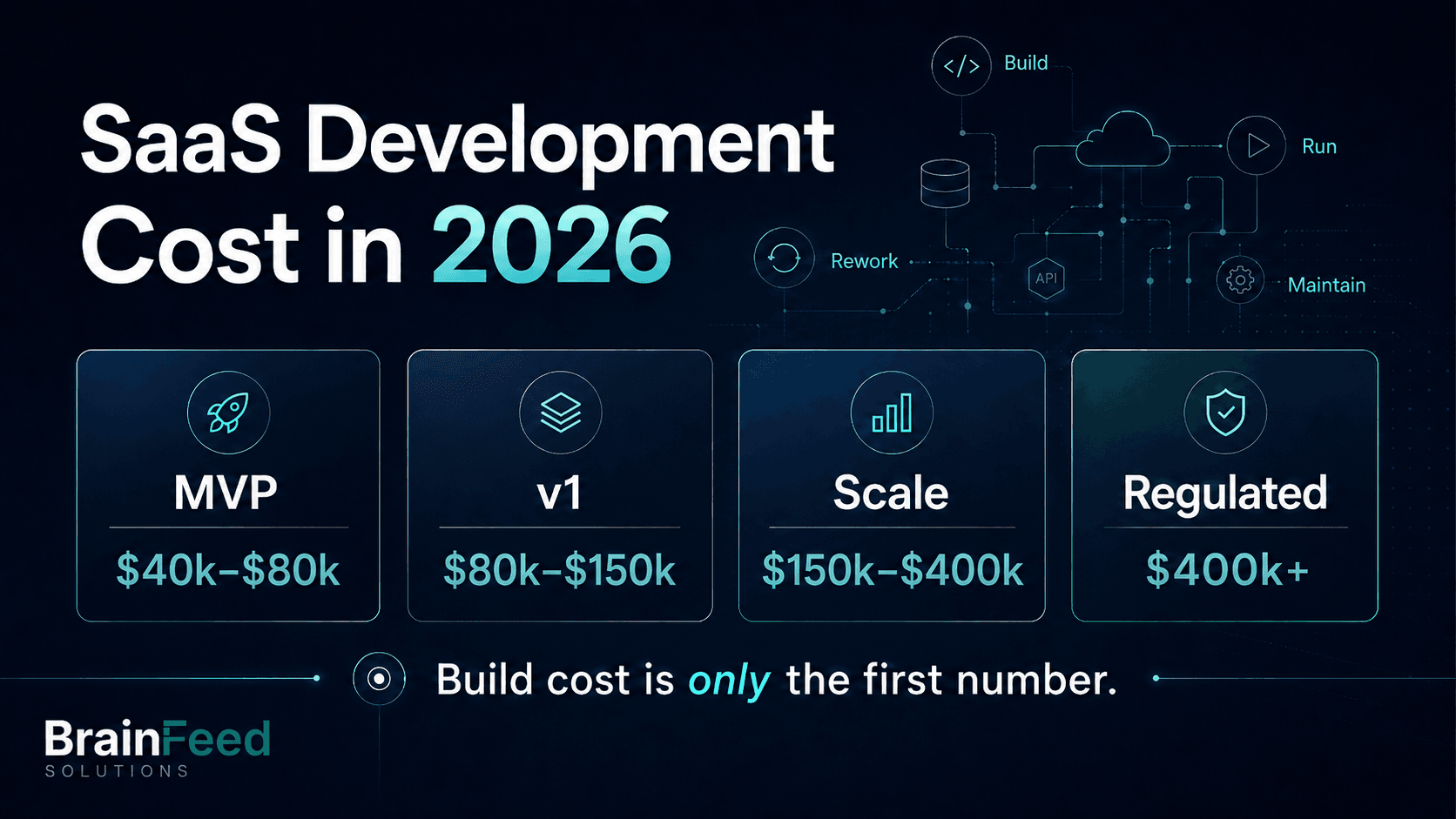
If you're still figuring out what the build will cost, our 2026 SaaS development cost breakdown breaks down the real numbers from MVP to production-ready v1, including where agencies typically hide the cuts.
And if you're pre-MVP and haven't locked your stack yet, the tech choices that come back to haunt SaaS MVPs is worth reading before you write a line of code — the decisions that look trivial at 100 users are the ones that are expensive to undo at 10,000.