TL;DR — In 2026, a real SaaS product costs $40,000–$150,000 to get to a credible v1, and most of that number is decided by four things: how much of it is genuinely custom, how senior the people writing the code are, how much rework the first build creates, and what you're paying to run and maintain it after launch. The sticker price agencies quote is the least interesting number. This is a breakdown of where the money actually goes — and where it quietly leaks.
This article is for:
- Founders and operators budgeting a SaaS build for the first time and trying to sanity-check a quote
- Teams that got wildly different estimates from three agencies and want to understand why
- Anyone deciding between offshore, onshore, and hybrid teams on cost grounds
This article is NOT for:
- Teams looking for a per-feature price list to copy-paste into a spreadsheet — costs don't work that way, and this explains why
- Enterprises with an existing platform and a procurement process; your cost drivers are governance and integration, not the ones here
- Readers who want the cheapest possible number regardless of what it buys — the whole point here is total cost, not sticker cost
The quick answer, with the honest caveat
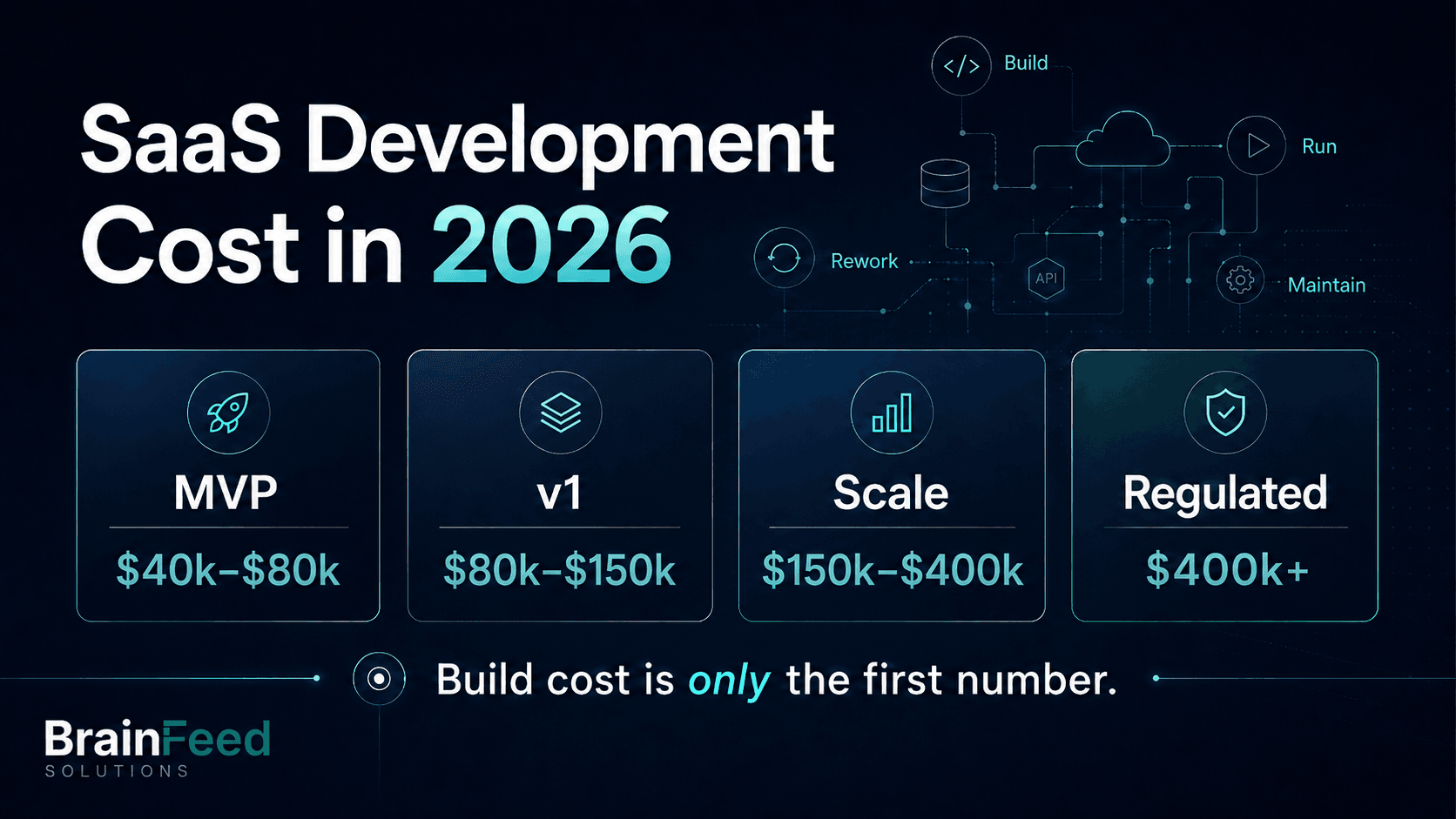
Here are the ranges we see hold up in 2026 for B2B SaaS products built by a competent team:
| Build stage | Typical cost | Timeline | What it is |
|---|---|---|---|
| Functional MVP | $40,000 – $80,000 | 2–4 months | Auth, billing, one core workflow, admin basics — a product you can charge for |
| Market-ready v1 | $80,000 – $150,000 | 4–7 months | Multi-tenancy, roles, reporting, integrations, real UX polish |
| Scaling build | $150,000 – $400,000 | 7–14 months | Performance work, deeper integrations, compliance, a real data platform |
| Complex / regulated | $400,000+ | 12+ months | Fintech, healthcare, multi-region, heavy compliance and audit surface |
These are market ranges consistent with what senior-led teams charge and with what we quote at BrainFeed. Specific figures below labelled as delivery estimates come from our own SaaS build and rebuild work, not vendor benchmarks.
The caveat that matters more than the table: two products with an identical feature list can differ 3x in cost, because "cost of SaaS development" is really the cost of decisions, not features. A login screen is cheap. A login screen that has to support SSO, MFA, an audit log, and tenant-level access policy is a different line item wearing the same name.
So instead of pricing features, price the four things that actually move the number.
Where the money actually goes
If you break a real SaaS quote apart, engineering hours on the visible features are rarely the biggest slice. A realistic v1 budget usually distributes something like this:
| Cost area | Typical share of budget | Why it matters |
|---|---|---|
| Product discovery & architecture | 10–15% | Prevents expensive rework later |
| Core product engineering | 40–50% | The actual SaaS workflows users pay for |
| Auth, billing, integrations & infrastructure | 15–25% | The plumbing that makes the product real |
| QA, deployment & handover | 10–15% | Turns code into a usable, maintainable product |
| Launch hardening & early fixes | 10–15% | The real-world issues that appear when users arrive |
The shares move with the product, but the shape holds: the visible features are only part of the invoice. What surrounds them — the architecture decisions before, the plumbing underneath, and the hardening after — is where a quote is won or lost. Four things drive whether those slices come in lean or bloated.
1. Custom vs. bought (the biggest lever). Every SaaS product is a mix of undifferentiated plumbing (auth, billing, email, file storage, background jobs) and the actual product. The plumbing is a solved problem — Clerk, Stripe Billing, Resend, and a managed queue will do it for a rounding-error monthly fee. Teams that rebuild that plumbing from scratch add 6–10 weeks of engineering to the invoice and buy nothing a customer will ever see. We wrote about exactly which of those decisions are expensive to reverse in Building a SaaS MVP: The Tech Stack Choices That Come Back to Haunt You — the cost story and the architecture story are the same story.
2. Seniority of the people writing the code. This is the line item that hides the most. A junior-heavy team at $30/hour and a senior-led team at $70/hour do not produce the same product at different speeds — they produce different products. The cheaper team's code costs less per hour and more per outcome, because the expensive part of SaaS isn't typing the feature, it's the data model, the tenancy boundaries, and the decisions that don't show up until month six. You are not buying hours. You are buying the decisions made inside those hours.
3. Rework. The single most underpriced cost in SaaS. A build that skips discovery, ships a single-tenant schema, and hard-codes the billing check will come in cheaper on the quote and more expensive in total, because retrofitting multi-tenancy or untangling ad-hoc billing logic is a week of high-risk work on a live database — per fix. Rework is where "cheap" builds become expensive builds; you just pay for it in month eight instead of month one.
4. What it costs to run and keep alive. The build is a one-time number. The product is a recurring one. Budget 15–20% of the build cost per year for maintenance — dependency updates, security patches, small features, the bugs real users find — plus infrastructure ($200–$2,000+/month at MVP-to-early-scale) and, increasingly, AI API spend if the product uses LLMs.
The framework to carry into any pricing conversation: sticker cost = build. Total cost = build + rework + run. Agencies compete on the first number. You live with the third.
A simple way to sanity-check your SaaS budget
Pricing isn't feature-by-feature, but you can still triangulate a defensible range before you talk to anyone. Start with the base product type, then adjust for complexity:
- One workflow, one user type, no billing complexity → lower end of the MVP range ($40k–$60k).
- Multi-tenant product with admin roles and real billing → mid-to-upper v1 range ($90k–$150k).
- Multiple integrations, reporting, or granular permissions → add meaningful budget on top of v1; these are not small features.
- AI features, audit logs, SSO, data migration, or compliance → treat each as a separate cost driver, not a bolt-on line item. Any one of them can move the number by five figures.
If your own estimate and an agency's quote are far apart — say, more than 25–30% — that gap is the conversation worth having. Someone is either scoping a different product or pricing in a corner they haven't told you about.
Where agencies quietly cut corners
Every gap between a low quote and a realistic one is a corner someone is planning to cut. These are the common ones, and what each costs you downstream.
- Discovery gets skipped. A quote with no paid discovery phase is a quote built on assumptions. The build proceeds, the assumptions turn out wrong in month two, and the change-order emails begin. Discovery isn't overhead — it's the cheapest place to be wrong.
- The data model is an afterthought. Single-tenant schemas that "we'll make multi-tenant later" are the most expensive four words in SaaS. Later means a migration touching every row and every query. The right schema on day one costs ten minutes; retrofitting it costs a careful week per table.
- Billing is bolted on. Skipping real billing to "add it when there are paying customers" scatters
if user.paidchecks across the codebase and turns the first pricing change into a refactor. - Testing is the flex line. QA is where a padded timeline gets recovered. The cost doesn't disappear — it moves to your support inbox and your reputation.
- "Done" excludes deployment, monitoring, and handover. A build that compiles on the developer's machine is not a shipped product. Error monitoring, CI/CD, and a documented handover are not extras; their absence is a corner.
None of these show up on a feature list. All of them show up in the total.
What "offshore" actually means for cost — and quality
The offshore conversation is usually framed dishonestly in both directions, so here's the version we'll actually defend.
The cheap-offshore promise is real, and so is its catch. A $20–$30/hour team genuinely is cheaper per hour. But per-hour price only translates to lower total cost when the work doesn't need rework — and rework rate correlates far more with seniority and process than with geography. A cheap build that has to be substantially rebuilt has an effective hourly rate far above the senior team you skipped. We know because a meaningful share of our SaaS work is rebuilds of cheaper first attempts — the client paid twice, and the second time cost more because it had a live product and real users to protect.
For example, one rebuild we took on started as a low-cost MVP with single-tenant assumptions baked into the database. By the time the limitation surfaced, the product already had paying users — so the fix was no longer "change the schema." It was migration planning, data-safety checks, regression testing, and a staged rollout that couldn't drop a single customer's data. That is the rework tax in concrete terms: the same correction that costs ten minutes on day one costs weeks once real usage is riding on top of it.
Geography is not the quality variable. Seniority and ownership are. A senior-led offshore team and a senior-led onshore team produce comparable work; the offshore version costs less because the cost of living behind the rate is lower, not because the engineering is lesser. The failure mode people call "offshore quality problems" is almost always a juniority problem or a communication-structure problem wearing a geography label.
The honest anti-thesis — where we'd tell you not to hire us. If your build is genuinely commodity — a thin CRUD app, a well-trodden integration, an internal tool with three users and no roadmap — then a good freelancer or a lean cheap team is the correct economic call, and a senior-led shop is overkill you shouldn't pay for. Senior teams earn their premium on products where the early decisions compound: multi-tenancy, billing complexity, compliance, a real roadmap. On a build where nothing compounds, the premium buys you very little. Match the team to the stakes, not to the sales pitch.
This is exactly the offshore-quality question we'll go deeper on in an upcoming piece on what a senior-led offshore team actually delivers — it's the other half of this cost conversation.
Fixed-bid vs. time-and-materials: the pricing model is a cost driver too
How you're billed changes what you pay, and neither model is free.
Fixed-bid feels safe — one number, one deliverable. The cost is hidden in two places: the agency prices in a risk buffer (they eat the overruns, so they pad), and every change becomes a negotiation, which incentivises them to build exactly the spec even when the spec is wrong. Fixed-bid is genuinely right when the scope is truly known and stable — a well-defined migration, a clearly-bounded integration.
Time-and-materials feels risky — an open meter. The cost is discipline: it demands you actually engage weekly, review progress, and steer. Done well it's cheaper, because you're not paying a risk premium and you can cut scope the moment you learn something. Done badly — a disengaged client and an unaccountable vendor — it's how budgets quietly triple.
Most healthy SaaS builds we run are fixed-scope discovery, then time-and-materials build — you buy certainty where it's cheap (planning) and flexibility where it's valuable (building). If a vendor will fixed-bid a novel product sight-unseen, ask what buffer is baked in. There always is one.
The cost nobody budgets for: year two
The build cost gets all the attention because it's the number on the contract. The number that actually determines whether the product was a good investment is what happens after launch.
- Maintenance: 15–20% of build cost per year, minimum. A $100k build carries a realistic $15k–$20k/year just to stay current and stable.
- Infrastructure: $200–$2,000+/month scaling with usage; more if you're on premium managed services or moving real data volume.
- The rework tax: if corners were cut in the build, year two is when you pay for them — usually as a partial rebuild, at a worse time, with users watching.
A cheaper build that raises your year-two costs isn't cheaper. It's a loan with the interest hidden in the operations budget. The same logic applies across the board — we broke the post-launch numbers down for native apps in the mobile app development cost breakdown, and the pattern is identical: the build is the down payment, not the price.
How to get an estimate you can actually trust
The quality of a SaaS estimate tells you more about the team than the number does. A trustworthy estimate:
- Comes after a conversation about your data model and roadmap, not just your feature list. If nobody asked how multi-tenancy works or what's coming in month nine, the estimate is a guess.
- Separates build, run, and rework risk instead of quoting one hero number.
- Names what's bought vs. built — a good team tells you which parts they're not going to reinvent.
- Includes discovery, QA, deployment, and handover as line items, not as things that mysteriously happen for free.
- Is honest about where the range is wide and why — a $60k–$110k range with a clear explanation beats a suspiciously precise $74,500.
If a quote is a single number with no discovery, no run-cost, and no mention of tenancy or billing architecture, you're not looking at an estimate. You're looking at an opening bid in a change-order negotiation.
SaaS development cost FAQs
How much does it cost to build a SaaS product in 2026?
A credible v1 typically costs $40,000–$150,000 depending on how much is genuinely custom and how senior the team is. A functional MVP starts around $40k; a market-ready product with multi-tenancy, roles, reporting, and integrations lands in the $80k–$150k range.
Why do SaaS quotes vary so much for the same features?
Because you're pricing decisions, not features. The same feature list built junior-heavy with a single-tenant schema versus senior-led with proper tenancy and billing architecture can differ 2–3x in total cost — most of it showing up as rework later.
Is offshore SaaS development cheaper?
Per hour, yes. In total, only when the work doesn't need rework — and rework rate tracks seniority and process, not geography. A senior-led offshore team is genuinely cheaper for the same quality; a junior-heavy cheap team often costs more once you count the rebuild.
What should I budget for SaaS maintenance?
Plan for 15–20% of the build cost per year for maintenance and updates, plus infrastructure ($200–$2,000+/month) and any AI API usage. The build is a one-time cost; the product is a recurring one.
Should I choose fixed-bid or time-and-materials?
Fixed-bid for truly known scope (a bounded migration or integration). Time-and-materials for anything novel, where cutting scope as you learn is more valuable than a locked number. Many healthy builds use fixed-scope discovery followed by a T&M build.
How long does it take to build a SaaS MVP?
A functional SaaS MVP usually takes 2–4 months if the scope is tight: one core workflow, authentication, billing, admin basics, and deployment. A market-ready v1 typically takes 4–7 months, because it adds multi-tenancy, permissions, reporting, integrations, and real UX polish.
What to do next
If you're weighing a SaaS quote, the questions that separate a real estimate from an opening bid are less about price and more about these:
- What did they ask about your data model and roadmap before quoting?
- Which parts are they buying versus building — and can they name them?
- What's the year-two number, not just the build number?
A team that answers those confidently has shipped SaaS before. One that jumps straight to a single headline figure is quoting the sticker, not the total.
We build and rebuild SaaS products at BrainFeed — senior-led, from greenfield MVPs to scaling platforms with real payment volume. The SaaS development page explains how we structure discovery and estimation.
Already holding a quote? Send it to us with your product brief. We'll help you separate the real build cost from the hidden rework risk — the year-two number, the tenancy and billing assumptions, the corners you can't see on a feature list — before you commit. Get a quote review →