Last updated: September 2026
A mobile app in 2026 can cost anywhere from $12,000 for a lean, single-purpose MVP to $600,000+ for a complex enterprise platform. Most business apps with user accounts, payments, APIs, an admin panel and push notifications land between $50,000 and $180,000.
This guide breaks down where that money goes: complexity, platform, features, hidden costs, industry, and who you hire to build it. It's written for founders and product owners budgeting a first or second app. If you already have a feature list and want a number for your project, our mobile app development services team can scope it.
Quick Answer: How Much Does Mobile App Development Cost in 2026?
In 2026, mobile app development typically costs:
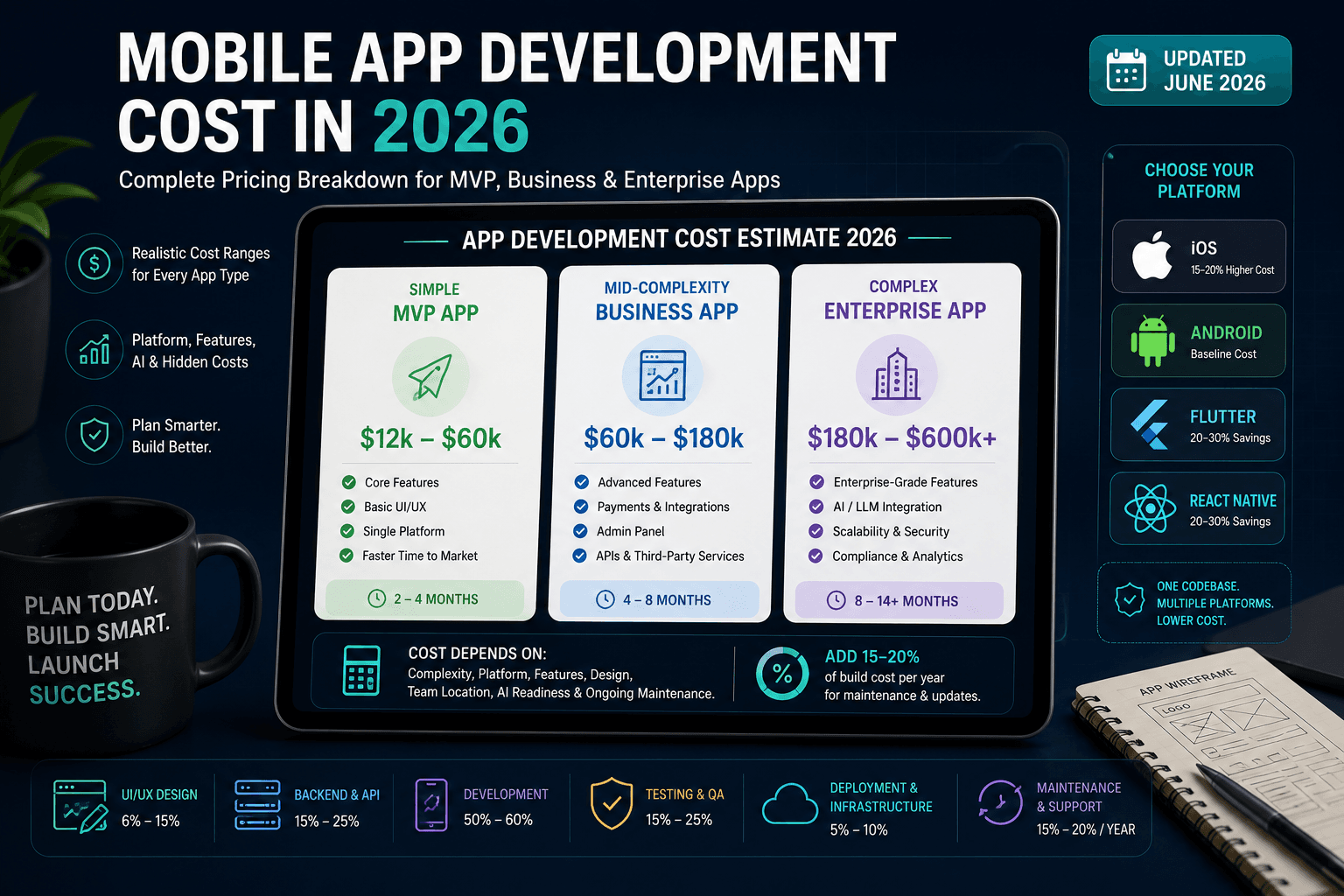
- Simple MVP app: $12,000 - $60,000
- Mid-complexity business app: $60,000 - $180,000
- Complex or enterprise app: $180,000 - $600,000+
Most serious business apps fall between $50,000 and $180,000, depending on features, platforms, design depth, backend complexity, compliance, and whether AI/LLM features are included.
As a rule of thumb, budget an additional 15-20% of the build cost per year for maintenance, updates, OS compatibility, bug fixes, and security patches.
At a Glance: Mobile App Cost by Type (2026)
| App Type | Typical Cost | Timeline | Best For |
|---|---|---|---|
| Simple MVP | $12k - $60k | 2-4 months | Validation, internal tools, simple workflows |
| Mid-complexity app | $60k - $180k | 4-8 months | Payments, APIs, admin panel, push notifications |
| Complex app | $180k - $600k+ | 8-14+ months | Fintech, healthcare, marketplaces, AI-heavy apps |
What Determines Mobile Application Development Cost?
The cost of developing a mobile app varies with four main drivers: complexity, platform choice, team location, and, increasingly, AI features.
Key Factors Affecting Your App Development Budget:
App Complexity Level
- Simple Apps: $12,000 - $60,000
- Moderate Apps: $60,000 - $180,000
- Complex Apps: $180,000 - $600,000+
Platform Choice
- Native iOS: 15-20% higher cost
- Native Android: Standard baseline cost
- Cross-platform (React Native / Flutter): 20-30% cost savings
Development Team Location
- North America: $120-$220/hour
- Western Europe: $90-$160/hour
- Eastern Europe: $45-$90/hour
- Asia: $25-$70/hour
Reading these bands: seniority moves the rate as much as location does. Senior developers with AI integration experience sit at the top of each band, so treat these as a starting point for budgeting, not a quote.
Platform-Specific Mobile Application Development Cost
iOS App Development Cost in 2026
Developing for iOS typically costs 15-20% more than Android due to:
- Stricter App Store guidelines covering safety, performance, design, business model, and legal compliance, including responsibility for third-party SDK compliance
- Need for multiple device compatibility
- Higher developer hourly rates
- Longer review and approval processes
Average iOS Development Cost:
- Simple app: $18,000 - $70,000
- Medium complexity: $70,000 - $200,000
- Complex app: $200,000 - $700,000
Android App Development Cost in 2026
Android development often serves as the cost baseline:
- Largest global market share across emerging markets
- More flexible development environment
- Broader device compatibility requirements (fragmentation remains a factor)
Average Android Development Cost:
- Simple app: $15,000 - $60,000
- Medium complexity: $60,000 - $180,000
- Complex app: $180,000 - $600,000
Cross-Platform Development Cost
React Native and Flutter have both matured and are now common choices for many non-gaming business, SaaS, marketplace, and content-driven mobile apps. Cross-platform can reduce mobile app development cost by 20-30%:
- Single codebase for iOS, Android, and (with Flutter) web
- Shorter delivery, because most features are built once instead of twice
- Shared maintenance and future AI SDK integrations
- Suitable for most business, marketplace, SaaS, e-commerce, and content-driven apps
Native still wins for hardware-intensive apps, games, and apps that depend on the newest platform-specific APIs on day one.
Feature-Based Cost Breakdown for 2026
Understanding how specific features affect your mobile app development cost helps with accurate budgeting:
Essential Features Cost Range:
- User Registration/Login: $2,500 - $6,000
- User Profiles: $3,500 - $8,000
- Push Notifications: $3,000 - $7,000
- Search Functionality: $3,500 - $9,000
- Basic UI/UX Design: $6,000 - $18,000
Advanced Features Cost Range:
- Real-time Chat: $9,000 - $22,000
- Payment Integration: $6,000 - $18,000
- GPS/Location Services: $7,000 - $20,000
- Camera Integration: $5,000 - $14,000
- Offline Functionality: $9,000 - $28,000
Premium Features Cost Range:
- AI/Machine Learning: $18,000 - $60,000
- LLM / Generative AI Integration: $20,000 - $70,000 (see below)
- AR/VR Integration: $22,000 - $90,000
- IoT Connectivity: $14,000 - $45,000
- Advanced Analytics: $12,000 - $35,000
- Multi-language Support: $6,000 - $18,000
LLM and Generative AI Features in 2026
AI assistants, on-device summarisation, and LLM-powered search are increasingly common feature requests in 2026. See our workflow automation and AI integration services if you're evaluating how AI fits into your product. Typical cost breakdown:
- In-app AI chat / assistant: $15,000 - $40,000 (API-based, e.g. Claude, GPT)
- On-device AI inference (Core ML / TensorFlow Lite): $25,000 - $70,000
- AI-generated content or recommendations: $12,000 - $35,000
- RAG / knowledge-base integration: $20,000 - $55,000
These costs include prompt engineering, model selection, safety guardrails, and latency optimisation, not just the API calls.
Hidden Costs in Mobile Application Development (2026)
Many businesses underestimate the total mobile app development cost by overlooking these expenses:
Pre-Development Costs
- Market Research: $2,500 - $9,000
- Technical Documentation: $3,500 - $12,000
- Wireframing & Prototyping: $6,000 - $18,000
- UI/UX Design: $9,000 - $28,000
Post-Launch Costs
- App Store Optimisation: $2,500 - $9,000
- Marketing & User Acquisition: $10,000 - $100,000+
- Maintenance & Updates: 15-20% of development cost annually
- Server & Infrastructure: $600 - $6,000+ monthly
- AI API costs (if applicable): $200 - $5,000+/month depending on usage
Quality Assurance Costs
- Testing & QA: 15-25% of total development cost
- Security Audits: $4,000 - $18,000
- Performance Optimisation: $6,000 - $22,000
Mobile Application Development Cost by Industry (2026)
Different industries have different cost profiles based on complexity and compliance needs:
E-commerce Apps
- Cost Range: $60,000 - $350,000
- Key Features: Payment processing, inventory management, user accounts, personalised recommendations
- Timeline: 4-8 months
Healthcare Apps
- Cost Range: $90,000 - $550,000
- Key Features: HIPAA/GDPR compliance, patient data security, telemedicine, AI symptom checking
- Timeline: 6-12 months
Fintech Apps
- Cost Range: $120,000 - $500,000
- Key Features: Open banking integration, security protocols, compliance, fraud detection AI
- Timeline: 8-14 months
SaaS Apps
SaaS mobile apps typically sit on top of an existing web platform, adding native UI, push notifications, and offline support. Costs vary widely based on whether the API layer is already built. If the web platform itself is still to be built, our SaaS development cost breakdown covers that side of the budget.
- Cost Range: $50,000 - $250,000 (mobile client on top of existing SaaS)
- Key Features: Auth, subscription gating, offline sync, real-time data, push notifications
- Timeline: 3-7 months
Social Media Apps
- Cost Range: $80,000 - $400,000
- Key Features: Real-time messaging, content sharing, AI content moderation, user engagement
- Timeline: 5-10 months
How to Optimise Your Mobile Application Development Cost
1. Start with an MVP (Minimum Viable Product)
Launch with the one user journey that proves the idea, then build from real usage:
- Focus on essential functionality
- Gather user feedback early
- Add features, including AI, based on validated user demand
A focused mobile MVP with us starts at around US$12,000. See how we scope and build them on our MVP development services page, and read the stack decisions that are cheap in week one and expensive later.
2. Choose the Right Development Approach
- Native: Higher cost, best performance, required for hardware-intensive or deeply platform-specific apps
- Cross-platform (Flutter / React Native): Lower cost, faster development, and suitable for most business, marketplace, SaaS, e-commerce, and content-driven apps
- Hybrid: Balanced approach for content-heavy or web-wrapper apps
3. Start AI-Ready, Not AI-Heavy
The biggest cost trap in 2026 is building AI features before product-market fit. Design your app architecture for AI from day one (clean APIs, structured data, event tracking) but defer LLM features until you have the usage patterns to justify them.
4. Partner with the Right Development Team
- Evaluate portfolios and case studies
- Confirm hands-on experience with current supported Flutter and React Native releases, modern app architecture, CI/CD, app-store deployment, and long-term maintenance
- Consider long-term maintenance and AI iteration capabilities
- Balance cost with quality and domain expertise
Mobile App Development Cost by Team Type
Who you hire shapes the budget as much as what you're building. Here's how the main options compare:
| Team Type | Typical Cost | Best For | Watch Out For |
|---|---|---|---|
| Freelancer | $10,000 - $80,000 | Small MVPs, prototypes, narrow features | Limited capacity, harder long-term support |
| Small Agency | $40,000 - $200,000 | Business apps, SaaS apps, e-commerce apps | Quality varies by team seniority |
| Specialist Product Team | $100,000 - $500,000+ | Complex, scalable, compliance-heavy apps | Higher upfront cost |
| In-house Team | $250,000+/year | Long-term product companies | Hiring, management, and retention costs |
For most SMBs and startups launching their first or second app, a small-to-mid-size agency with a proven portfolio is the practical middle ground: you get team continuity, project management, and ongoing maintenance without the overhead of building a team in-house.
How Much Does It Cost to Hire an App Developer?
The hiring model moves the cost more than any single developer's rate. There are three common routes.
Hiring a freelance app developer
Freelancers bill by the hour or by fixed milestone, broadly within the regional bands above. The hourly rate is only part of the budget: a 600-hour MVP at $50/hour is $30,000 of development time before design, QA, and project management, which a solo freelancer either does alongside the build or leaves to you.
A freelancer is the right call for a prototype, a narrow feature, or a small MVP where you (or a technical co-founder) can review the code and manage the work.
Hiring an agency or development team
Agencies usually quote a fixed project price or a monthly team retainer. The hourly rate is higher than a freelancer's in the same region because it covers design, QA, project management, and continuity if someone leaves the project. Compare total project cost, not hourly rates: a team at a higher rate that ships in fewer hours with less rework can cost less overall.
If you're considering an offshore team, here's what a senior-led offshore team should actually deliver, and the questions to ask before you sign.
Hiring an in-house app developer
The US Bureau of Labor Statistics puts the median annual wage for software developers at $135,980 (May 2025). The real cost of a hire is higher once you add benefits, payroll taxes, equipment, recruiting, and management time. A production app also rarely needs just one person: someone has to cover mobile, backend, design, and QA.
| Hiring Model | How You Pay | What's Included | Best For |
|---|---|---|---|
| Freelancer | Hourly or fixed milestones | Development, sometimes design | Prototypes, narrow features, small MVPs |
| Agency / development team | Fixed project price or monthly retainer | Design, development, QA, project management, handover | MVPs through complex apps, when you need a whole team without hiring one |
| In-house developer | Annual salary plus benefits and overhead | Whatever you hire for, managed by you | Apps that are your core product, with a multi-year roadmap |
When in-house is the better call: if the app is your product and you expect to ship changes every week for years, an agency is a bridge, not the destination. Use outside help for speed on the first version, but plan the handover from day one: code in your repository, accounts in your name, and documentation a new hire can pick up.
2026 Mobile App Development Cost Estimation Tool
Use this framework to estimate your mobile app development cost:
Base Development Cost Formula: Estimated Build Cost = (Estimated Hours × Hourly Rate) × Platform Factor + Third-Party / AI Add-ons + Post-Launch Budget
Example Calculation:
- Mid-complexity e-commerce app: 900 hours
- Development rate: $85/hour
- Base cost: $76,500
- iOS premium: +15% = $11,475
- AI product recommendations add-on: $18,000
- Total estimated cost: $105,975
Not sure where your app fits in these ranges? Send us your feature list and we'll give you a realistic budget estimate before you commit to a full build. Get a free estimate
Frequently Asked Questions
How much does it cost to build a mobile app in 2026?
Most mobile apps cost between $12,000 and $600,000+, but a typical business app usually falls between $50,000 and $180,000 depending on features, platforms, and complexity.
How much does an MVP app cost?
A lean, single-purpose MVP typically costs $12,000 to $60,000 and takes 2 to 4 months. The low end covers one core user journey on a single cross-platform codebase with a simple backend. Payments, real-time features, or compliance requirements push it toward the top of the range.
How much does iOS app development cost?
A simple iOS app typically costs $18,000 to $70,000, a medium-complexity app $70,000 to $200,000, and a complex app $200,000 to $700,000. iOS usually runs 15-20% more than Android because of stricter App Store review requirements, device compatibility testing, and higher developer rates.
How much does Android app development cost?
A simple Android app typically costs $15,000 to $60,000, a medium-complexity app $60,000 to $180,000, and a complex app $180,000 to $600,000. Android is usually the cost baseline, although testing across a wider range of devices adds QA time.
Is Flutter or React Native cheaper than native development?
For most business and consumer apps, yes. Cross-platform development with Flutter or React Native can reduce cost by 20-30% because a single codebase supports both iOS and Android.
How much does it cost to hire an app developer?
It depends on the hiring model. Freelancers bill hourly, from around $25/hour in parts of Asia to $220/hour for senior developers in North America. Agencies usually quote a fixed project price or a monthly retainer that includes design, QA, and project management. An in-house hire in the US costs more than salary alone: the BLS median annual wage for software developers was $135,980 in May 2025, before benefits and overhead.
How much should I budget for app maintenance?
Plan for 15-20% of the initial development cost per year. This covers OS updates, security patches, bug fixes, and feature iterations.
How much does AI integration add to mobile app cost?
Basic API-based AI features (like an in-app assistant) can add $15,000 - $40,000. More advanced implementations, such as RAG, on-device inference, or generative AI, can add $20,000 - $70,000 or more.
What's the fastest way to reduce mobile app development cost?
Start with an MVP that covers only your core user journey, and build it cross-platform unless you need native performance. Every feature you defer until real users ask for it is budget you keep, and you'll have usage data to guide what to build next.
Getting an Accurate Cost Estimate for Your App
Every range in this guide moves with your feature list, platform choice, compliance needs, and who builds it. The fastest way to a real number is a short scoping conversation about your specific app.
Get a Mobile App Cost Estimate
Send us your feature list and we'll come back with a realistic budget range, with no commitment required.
What you'll get:
- Detailed project scope analysis
- Realistic cost range based on your specific features
- Timeline and milestone planning
- Technology stack recommendations (including AI/LLM fit assessment)
- A transparent breakdown with no hidden surprises