Short answer: how much does Shopify Plus cost in 2026? In US dollars, Shopify's help centre lists Plus at $2,500 a month on a 1-year term and $2,300 a month on a 3-year term (checked 13 Nov 2026). Shopify says more complex, higher-volume businesses may also pay a variable platform fee on top, and it does not publish that rate. The monthly fee is the smaller part of the decision: the features it gives you, and the build work to use them, are what you are really buying.
If you are on Advanced and looking at the Plus price, the question is rarely "can we afford $2,300?" It is "which constraint are we hitting that Advanced cannot remove?" This note gives you the published numbers, a way to test the fee arithmetic against your own sales, and the costs that sit outside the plan price.
This article is for:
- Merchants on Advanced who are close to a plan limit (staff, locations, B2B catalogs, checkout)
- Ops and finance leads who need the Plus fee and its extras in one place for a business case
- Technical leads scoping a migration to Shopify and deciding which plan to start on
This article is NOT for:
- Stores still finding product-market fit, where a lower plan is the right answer
- Anyone after a negotiated enterprise quote: Shopify sets the variable part of the price case by case
What Shopify publishes for Plus
Shopify's help centre lists the Plus monthly fee by billing currency and term length (checked 13 Nov 2026):
| Billing currency | 1-year term, per month | 3-year term, per month |
|---|---|---|
| USD | $2,500 | $2,300 |
| GBP | £1,950 | £1,800 |
| EUR | €2,250 | €2,100 |
| AUD | A$4,000 | A$3,700 |
| CAD | C$3,650 | C$3,400 |
Two details matter more than they look. First, the term is a commitment: Shopify's pricing FAQ says that on a 1- or 3-year Plus subscription you can cancel when the term ends. Second, the help page says "for standard setups and integrations"; for more complex, higher-volume businesses there may be a variable platform fee based on revenue and business model, different for B2B and direct-to-consumer orders. Shopify tells you to contact its Plus team for that rate, so any article that quotes a single percentage as fact is repeating something you should confirm in writing.
On a USD billing currency, the term choice is simple arithmetic. 3-year at $2,300 is $82,800 over the term. Taking the 1-year price for three years in a row is $90,000. At today's rates the 3-year commitment is $7,200 cheaper, about 8%, assuming the 1-year price does not change at renewal. That makes it a current-rate comparison, not a guaranteed saving, and you pay for it with three years of lock-in.
What the move adds over Advanced
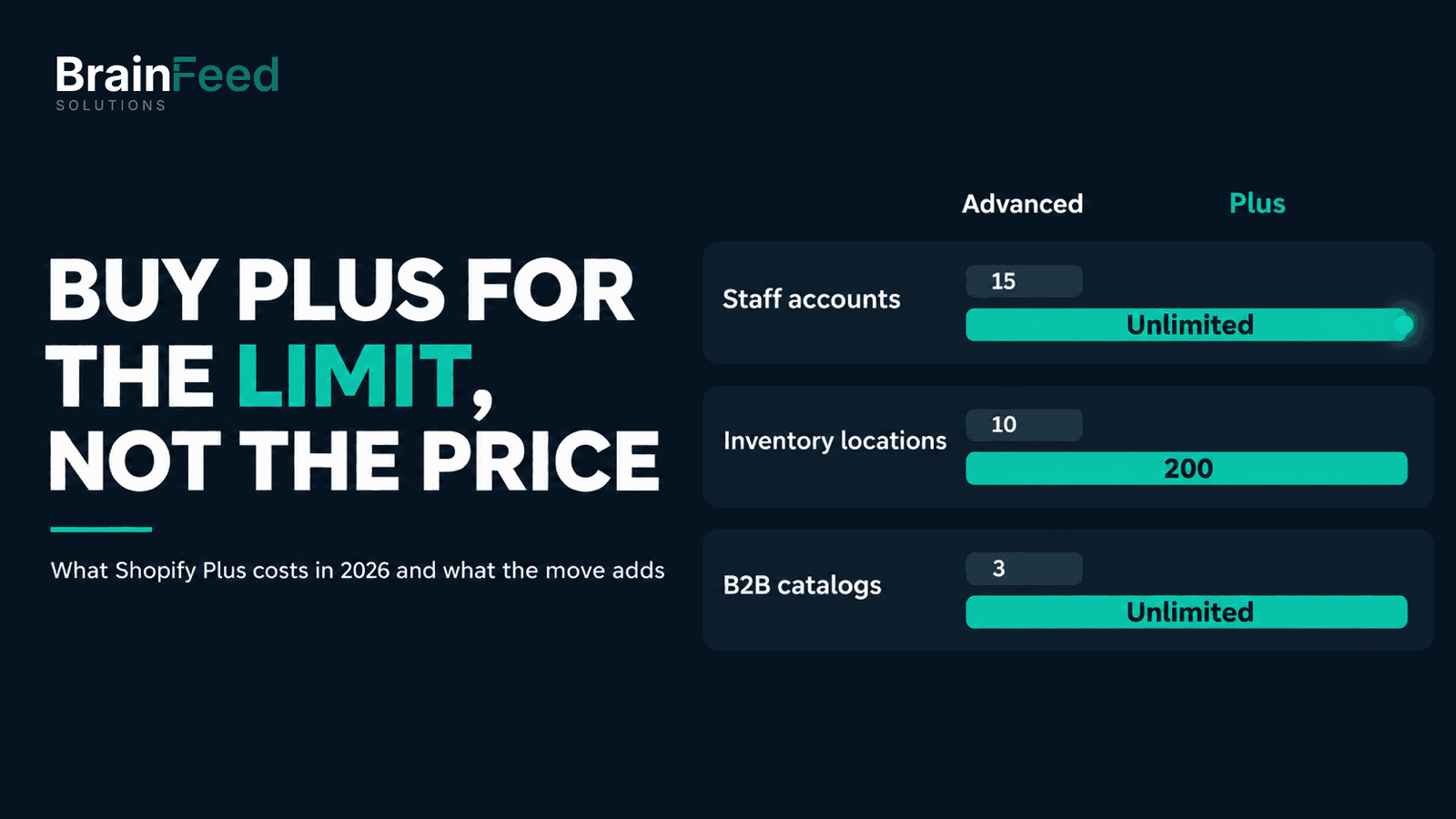
These come from Shopify's pricing comparison and its Plus plan help page (checked 13 Nov 2026):
| Advanced | Plus | |
|---|---|---|
| Staff accounts | 15 | Unlimited |
| Inventory locations | 10 | 200 |
| B2B catalogs | Up to 3 | Unlimited |
| Headless storefronts | 1 | 25 |
| Checkout customization | Limited | Full |
| API rate limits | Up to 2x on select APIs | Up to 10x on select APIs |
| Third-party payment provider fee | 0.6% | 0.2% |
"Full" is Shopify's label for the checkout row: it means access to Plus-only checkout tooling such as checkout UI extensions and the Checkout and Accounts Configuration API, not unrestricted access to checkout code. Shopify Functions need a more careful reading than a plan row. Stores on any plan can use public App Store apps that contain Functions. Only Plus stores can use custom apps that contain Function APIs, and some Functions capabilities are Plus-only. Plus also includes up to nine expansion stores (with conditions, covered below) and the first 20 POS Pro locations. If checkout logic is your reason for looking, our notes on checkout extensions versus Functions versus Scripts cover what each one can do. If headless is the reason, Liquid versus Hydrogen is the decision to make before you pay for 25 storefronts you may not build.
Does the lower third-party gateway fee pay for the plan?
On the fee gap alone, usually not. This section tests one thing only: the third-party gateway fee. It is not a full cost model. The 0.6% to 0.2% drop applies to third-party payment providers. If you process payments through Shopify Payments, Shopify's help centre says you pay no third-party transaction fee on those orders, so there is nothing to save.
For a store that does use a third-party gateway, the test is one line:
break-even monthly third-party-gateway sales = (Plus fee - Advanced fee) / 0.004
0.004 is the 0.4-point gap between the two rates. Whatever Advanced costs in your currency, the answer cannot exceed the Plus fee divided by 0.004: that is $575,000 a month on the 3-year USD price, $625,000 on the 1-year price. Where Advanced is not free, the true figure is lower, so run it with your own Advanced price from your regional pricing page.
A worked example in pounds, using Shopify's UK pricing (checked 13 Nov 2026): Advanced on yearly billing is £259 a month and Plus on the 3-year term is £1,800. The gap is £1,541 a month, so break-even is £1,541 / 0.004 = £385,250 of monthly third-party-gateway sales. On the 1-year Plus term (£1,950) the gap is £1,691 and break-even is £422,750. What this test leaves out: card rates on Shopify Payments, which differ by plan and which we have not modelled; POS Pro, where the first 20 locations are included on Plus (and up to 200 if you use Shopify Payments as your primary provider for retail locations, per Shopify) and which can matter a lot for a retail estate; per-store app charges; build work; and any variable platform fee. Check your region's pricing pages for those before you build a business case.
The takeaway: for a store on a third-party gateway, the gateway-fee gap only carries the case at high monthly volume. A fuller case adds the items above, which this note does not price. Start with the constraint in the table.
Costs outside the plan fee
- Variable platform fee. Not published; confirm with Shopify before you sign.
- Extended authorisation. Available only to Plus stores that use Shopify Payments, and only on certain cards: up to 30 days on Visa, Mastercard and American Express, up to 10 on Discover and JCB, 7 on Diners Club and China Union Pay. Manually capturing a payment after the standard 7 days adds a 1.75% charge on top of normal card fees. Shopify says periods and fees are subject to change.
- Expansion stores. Up to nine are included in the contract, with conditions. Each must be an extension of the main brand (same name and branding, same types of goods) and billed in USD or INR. Stores do not share data, settings or inventory by default, apps are billed per store, and every store needs its own theme licence. Shopify pre-approves international, B2B wholesale (one free per contract), wholesale-to-D2C (one free per contract), employee-only and physical retail stores.
- Apps and partners. Shopify's own page lists custom development, theme purchases and third-party apps as other potential costs, and gives no figures.
- Build work. A move to Plus is often a checkout, B2B or integration project. We scope that per store and do not quote a price in an article.
What breaks in production
The plan change is a billing event; the project around it is where stores lose time. Some Plus checkout customization is configuration (the checkout editor, Checkout Blocks) and some is code (checkout UI extensions, custom apps with Functions, and the Checkout and Accounts Configuration API, an Admin API that replaced the deprecated Checkout Branding API). Anything coded needs a rollback plan and a test pass before it replaces the default checkout. Dev stores cannot process transactions, so plan a pass on every payment method you offer on the live store. B2B catalogs and company locations need real customer data loaded and tested before wholesale buyers log in. The cost people forget is the term: a 3-year commitment is a bet that you will still want the features in year three.
When Advanced is the right call
Stay on Advanced if your limits are not binding: under 15 staff, under 10 locations, one storefront, no checkout customization that Advanced cannot do, and no need for more than three B2B catalogs. "We might need it" is not a constraint. You can move up when you hit one, and the 1-year term limits how long you are committed compared with three years.
The opposite case: if you need unlimited B2B catalogs, more than 10 locations, or checkout logic Advanced does not allow, the plan limits are your reason to move. Weigh the fee as one line next to build work, apps and any variable platform fee.
What to do next
- List the constraints you are hitting today against the table above. If you have none, stay put.
- Pull your regional Advanced and Plus prices and run the break-even line if you use a third-party gateway.
- Ask Shopify's Plus team in writing for the variable platform fee on your revenue and order mix.
- Choose 1-year unless you are sure of the 3-year fit.
- Scope the project around the plan: checkout, B2B and integrations. If you want a second opinion on the scope, see our Shopify development service, or Shopify migration if you are moving from another platform.
FAQs
How much does Shopify Plus cost per month? In USD, Shopify lists $2,500 a month on a 1-year term and $2,300 a month on a 3-year term. Higher-volume stores may also pay a variable platform fee that Shopify does not publish.
Is there a Shopify Plus transaction fee? Plus lowers the third-party payment provider fee to 0.2%, against 0.6% on Advanced. If you use Shopify Payments, Shopify charges no third-party transaction fee on those orders.
Can I cancel Shopify Plus before the term ends? Shopify's pricing FAQ says that on a 1- or 3-year Plus subscription you can cancel when the term commitment expires.
What does Plus include that Advanced does not? Unlimited staff accounts and B2B catalogs, 200 inventory locations, 25 headless storefronts, full checkout customization (including checkout UI extensions and the Checkout and Accounts Configuration API), custom apps that use Shopify Function APIs, and up to nine expansion stores, which must be extensions of the main brand.
Does moving to Plus mean a rebuild? Not always. Stores with default checkout and few integrations can often move with little build work. Custom checkout logic, B2B catalogs and ERP integrations are project work, scoped per store.