The Cheapest Quote Is Rarely the Cheapest Project
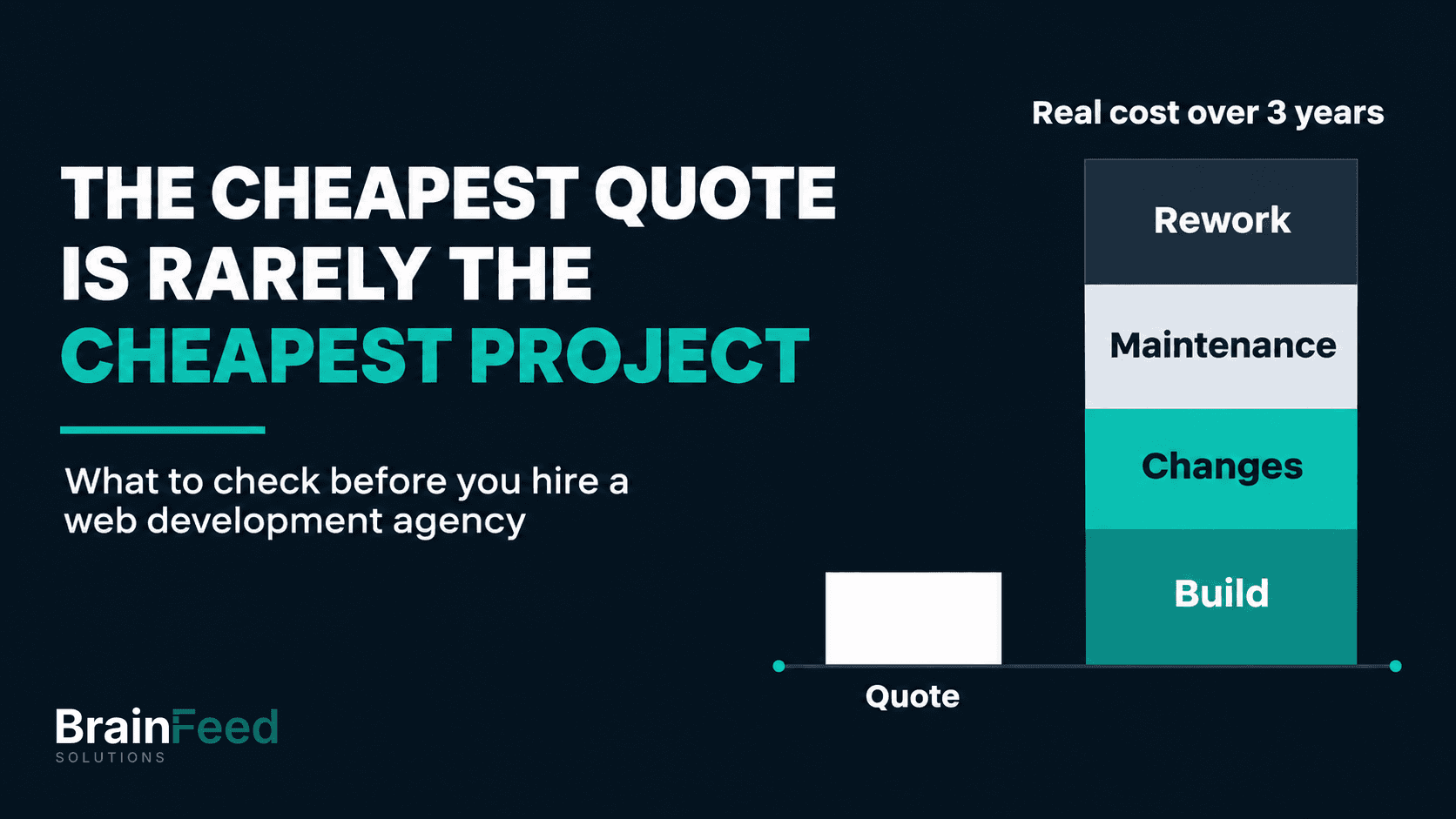
"Cost-effective" and "cheap" get used interchangeably, and that confusion is what lands businesses with a website they have to rebuild in eighteen months. Cheap optimizes for the invoice you sign today. Cost-effective optimizes for what the site costs you over three years - the build, plus the changes, fixes, hosting, and eventual rework that follow.
A $5,000 website that needs replacing next year is more expensive than a $15,000 site that runs reliably for five. The number on the proposal is the smallest part of the real cost. This guide is about finding the agency that gives you the lowest total cost, not the lowest bid.
Where the Real Cost Actually Lives
Before you compare agencies, understand what you are actually paying for over the life of a website:
| Cost | What it covers |
|---|---|
| Build | The one-time cost everyone quotes on. |
| Change | Every new page, campaign landing page, or feature after launch, usually billed by the hour once the project closes. |
| Maintenance | Hosting, security patches, plugin and dependency updates, uptime monitoring. |
| Rework | What you pay when a cheap first build has to be redone. |
The cheapest build often carries the most expensive everything-else. An agency that skips discovery, builds on a template it does not fully understand, and hands you no documentation will quote low and cost high. You feel it three months later, when every small change is a separate invoice and nobody can tell you why the contact form stopped sending.
Cost-effective means all four columns are reasonable, not just the first one.
Onshore, Nearshore, or Offshore
Location is often one of the largest influences on agency rates, though team seniority, scope complexity, and delivery model can matter just as much. The tradeoffs are real in every direction.
Onshore (same country) costs the most and buys you timezone overlap, straightforward contracts, and no language friction. For some businesses, heavily regulated or needing frequent in-person contact, that premium earns its keep.
Nearshore means a team in a nearby country or region, usually with more timezone overlap than a fully offshore team but lower costs than a domestic agency. It can be a useful middle ground, though the actual advantage depends more on communication, seniority, and process than on geography alone.
Offshore (India, Eastern Europe, Southeast Asia) can cut rates by half or more, because those teams price to local economies. The talent pools are deep and, at the senior end, every bit as capable. The old "offshore equals junior developers plus timezone hell" assumption is fifteen years out of date for teams that are senior-led. What you actually trade is timezone overlap and, with weaker agencies, communication discipline.
The mistake is not choosing offshore. It is choosing offshore and then choosing the cheapest offshore option, which strips out exactly the senior oversight that makes offshore work. We run senior-led from India for that reason: the rate advantage of the region, without the coordination tax of a junior team you have to manage yourself.
Compare options quickly, but weigh the whole engagement, not the hourly rate.
How Agencies Usually Price Website Projects
Agencies generally price website work using one of four models. None is inherently better; the right one depends on how well-defined your project is.
| Model | Best suited to | Main risk |
|---|---|---|
| Fixed project fee | Clearly scoped builds | Changes become chargeable variations |
| Time and materials | Complex or evolving projects | Final cost is less predictable |
| Monthly retainer | Continuous improvement and support | Poor value if the workload is inconsistent |
| Dedicated team | Long-term product development | Requires enough ongoing work to justify |
Rates vary widely by region and seniority, so a like-for-like comparison matters more than a headline number. A typical small-business website often starts in the low five figures once design, build, and launch are included, and scales from there with complexity. The cheapest hourly rate does not necessarily produce the lowest project cost. Compare the estimated hours, team seniority, included deliverables, and post-launch obligations, not just the rate.
What Actually Drives the Price
Three things move a web development quote more than anything else:
- Scope clarity. A vague brief always costs more, because the gaps turn into change orders. The single biggest lever you control is handing over a clear, complete brief.
- Team seniority. Senior developers cost more per hour and less per project. They make fewer expensive mistakes and need less management.
- Technology choice. A platform your own team can maintain (WordPress, Shopify, Webflow) costs less over time than a bespoke stack only the agency understands.
A higher rate from a senior, sector-experienced team frequently produces the lower total cost. Cheap-by-the-hour is where budgets quietly overrun.
How to Compare Agency Proposals
When two quotes both say "full website," the total is the least useful number to compare. Put these items side by side instead:
- Discovery and planning included
- Number of page templates
- Content creation and migration responsibilities
- CMS and technology stack
- Integrations
- SEO migration and redirects
- Analytics and tracking setup
- Testing and accessibility
- Training and documentation
- Hosting and maintenance
- Post-launch support
- Team members assigned to the project
- Estimated timeline
- Exclusions and change-request rates
For a redesign specifically, the scope items that generate the most change-order disputes - content migration, integrations, redirects, and support - are worth reading before you brief anyone. Our guide to what website redesign services include walks through exactly what sits inside a standard scope and what falls outside it.
Match Their Experience to Your Problem
An agency that has built for your sector, platform, or problem before will be cheaper, not because they charge less, but because they have already solved the hard parts. They know where a Shopify migration leaks, or what a CRM integration actually takes, so they do not bill you for their learning curve.
Ask for two or three projects close to yours and talk to those clients. The question is not "was it good?" It is "was it delivered on time, on budget, and what surprised you?" The surprises are where the money goes.
Read the Agency's Own Website First
An agency's own website is an important capability signal. It is the one project where they were the client, the budget, and the deadline at once, so a slow, outdated, or poorly structured site should prompt questions about the standards they apply to client work.
Look at load speed, how it behaves on mobile, and whether the case studies describe outcomes ("cut checkout abandonment by a fifth") or just deliverables ("built a website"). Outcome language means they think past launch. Deliverable language means they think in invoices.
Know Who Actually Does the Work
You can hire a well-reviewed agency and still get a junior team. Some firms win the pitch with senior people, then staff the build with whoever is free, or quietly re-outsource it.
Before you sign, ask to meet the developers and the project manager who will actually run your build. A serious agency introduces them without hesitation. Reluctance to introduce the delivery team is a significant warning sign, particularly when senior staff led the sales process.
Cost-Effective Means Post-Launch, Too
The invoice-cheap agency treats launch as the finish line. The cost-effective one treats it as the start of the relationship that determines your real spend.
Ask what happens after go-live: who monitors uptime, who applies security updates, how changes get requested and priced, and whether you get a documented handoff and CMS training. For a typical marketing website, your team should be able to make routine content changes without paying development rates for every edit.
Red Flags in a Suspiciously Cheap Quote
A very low quote is not automatically a bad one, but it usually buys its price somewhere. Look for what is missing:
- No discovery phase
- No named, countable deliverables
- No allowance for content creation or migration
- Unclear team composition, or no named people
- No described QA or testing process
- A proprietary CMS that locks you in
- No handover documentation or training
- A rock-bottom price paired with "unlimited revisions"
Any one of these can be fine in isolation. Two or three together usually means the real cost lands later, as change orders, rework, or a rebuild.
The Short Version
The cost-effective agency is rarely the one with the cheapest quote. It is the one that scopes clearly, staffs seniors, builds on a platform you can maintain, and is still useful to you the day after launch.
At BrainFeed, senior team members stay involved from discovery through architecture and launch, rather than handing the project to a junior delivery team after the sales call. If you are weighing options for a build or redesign, our web design and development services begin with discovery and a written scope that defines deliverables, responsibilities, and exclusions before development starts. That gives you a more reliable budget and fewer mid-project surprises.