TL;DR - "Shopify development services" is a catch-all for at least nine distinct kinds of work: store setup, custom theme development, app development, headless builds, integrations, migrations, performance engineering, checkout/conversion work, and ongoing support. No single store needs all nine. A good service offering scopes the two or three you actually need, wraps them in a real process (version control, code review, a staging environment, a QA matrix, and a documented handoff), and tells you plainly what it does not cover. If a proposal reads like a feature list with no phases and no exclusions, you are reading marketing, not scope.
Search "shopify development services" and every agency on page one claims to offer them. The phrase has become a header on a services page rather than a description of work - which means two quotes labelled "Shopify development services" can differ by a factor of ten and still both be honest, because they are quietly describing completely different engagements.
This article is the map. Not a sales pitch for any one type of work, but the full taxonomy of what the phrase can contain, what a complete engagement includes at each phase, and how to hold a proposal up against that standard. If you know which parts of this map you're actually buying, the ten-times price spread stops being confusing and starts being informative.
This article is for:
- Store owners and founders comparing Shopify development quotes that don't line up
- Anyone who has been told "yes, we do that" to every question and wants a way to pressure-test it
- Operators scoping a Shopify project internally before they go to market for an agency
This article is NOT for:
- Merchants who need a paid theme installed and nothing customised - that's a setup task, not a development service
- A Liquid or React tutorial - this is about the shape of the engagement, not the code
- Shopify Plus or enterprise teams with in-house engineering and a formal procurement process already in place
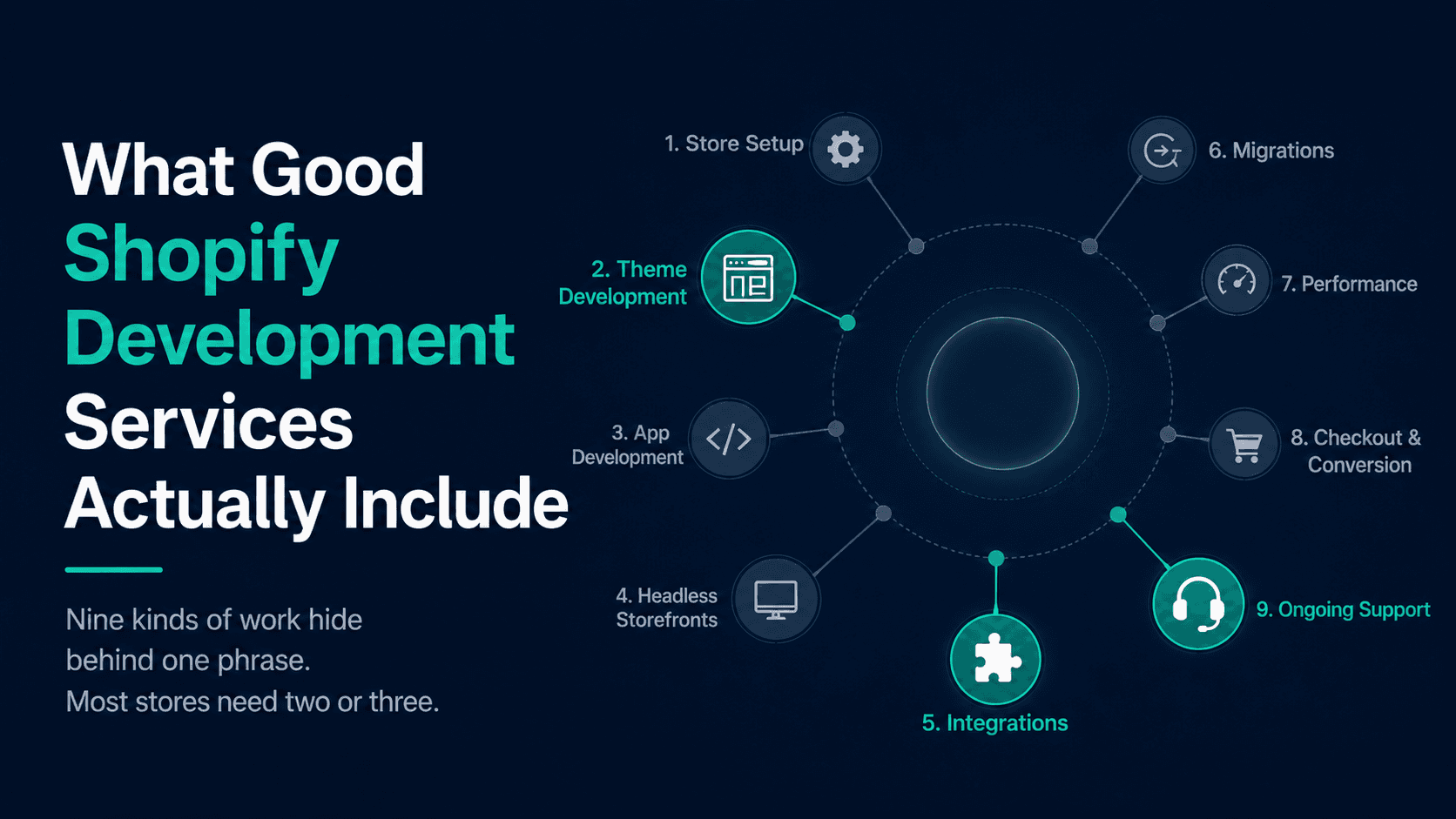
The nine things "Shopify development services" can mean
Almost every Shopify engagement is a combination of these. The skill of a good Shopify development company is telling you which two or three you need and which you're being upsold.
1. Store setup and configuration. Domains, DNS, email routing, tax and shipping zones, payment providers, a paid theme installed and configured. Real work, but it's configuration, not development. Usually priced in hours or as a small fixed package, not as a multi-week custom build. If a "development" quote is mostly this, you're overpaying for a setup task.
2. Custom theme development. Building or heavily modifying a theme in Liquid on Online Store 2.0 - custom sections, metafield-driven content, bespoke product and collection templates. This is the most common genuine development engagement and the one most stores actually need. Where the line sits between a Liquid theme and a headless build is its own decision, and we've mapped exactly where that line falls.
3. App development. A custom app built for one merchant or a public Shopify App Store app - a B2B pricing engine, a wholesale portal, a warehouse sync, or subscription logic Shopify doesn't provide natively. Typically built against Shopify's GraphQL Admin API. Embedded admin apps often use App Bridge and Shopify's recommended React Router stack, while Ruby, PHP, Node, Go, and .NET libraries remain available. This is where budgets climb, because you're building software, not styling a store.
4. Headless storefronts. A custom front-end that pulls commerce data from Shopify through the Storefront API. This may use Hydrogen's established React Router stack, Next.js, or another supported framework; Shopify is also developing a framework-agnostic version of Hydrogen, currently in developer preview. Justified only at a specific ceiling of content complexity or front-end control. Most SMB stores do not need it, and buying it "to be fast" is one of the most common expensive mistakes in this list.
5. Integrations and data flows. Connecting Shopify to an ERP, a 3PL, a CRM, an email platform (Klaviyo), a helpdesk (Gorgias), an accounting system, or a payments layer. Each integration is its own mini-project with its own failure modes. A store that needs Stripe alongside Shopify Payments, for instance, is making a more technical decision than it looks. "Integration" in a single line item is a red flag - real integrations get line-itemed individually.
6. Migrations. Moving onto Shopify from WooCommerce, Magento, or a custom platform - or replatforming a Shopify store to headless. Product data, URL redirects for SEO, customer records, order history, and app parity. The risk isn't the build; it's the data and the redirects.
7. Performance engineering. Core Web Vitals work, image and script optimisation, app-bloat auditing, theme code cleanup. Often sold as "we'll make it fast" with no target. Good performance work names field targets - LCP at 2.5s or less, INP at 200ms or less, CLS at 0.1 or less, measured at the 75th percentile - then uses Lighthouse and lab testing to diagnose what's keeping the store from reaching them.
8. Checkout and conversion engineering. Custom checkout UI and logic through Checkout Extensibility (the old checkout.liquid editing path is gone), Shopify Functions for discounts and shipping rules, upsells, and post-purchase flows. Availability depends on the checkout surface, your Shopify plan, and whether the functionality ships through a public or custom app - the deepest in-checkout UI work generally requires Shopify Plus. This is where revenue is won or lost, and it carries the strictest QA requirements of anything on this list.
9. Ongoing support and maintenance. Post-launch retainers, app updates, seasonal changes, bug fixes, and small feature work. Not a project - a relationship. Usually the most valuable line and the one most often left undefined until something breaks.
The counterpoint worth stating plainly: a "full-service" agency that lists all nine as equal strengths is describing a marketing page, not a team. Depth clusters. Ask which two or three they build most often, and ask for live URLs.
What a complete engagement includes at every phase
Whichever of the nine you're buying, a complete service runs the same lifecycle. The deliverables below are what separate a scoped engagement from "we'll start building and see how it goes." Each phase deserves more depth than one article allows - the scoping, QA, and handoff phases especially - which is why the founder's guide to what a custom build actually delivers covers the failure modes in detail. Here is the checklist version:
- Discovery - a technical discovery call and a written brief that maps your requirements against Shopify's native capabilities before a fixed price is quoted. A quote from a mockup alone is a quote for a guess.
- Specification - a written feature list describing behaviour, not just a Figma showing appearance. "The cart updates without a page reload" is a spec; the picture of the cart is not.
- Design - or a design review, if you're bringing your own. Named browser and device support, not "modern browsers."
- Build - in version control, in a repository you will own, with more than one person able to read the code.
- QA - against a defined matrix: checkout tested using Shopify Payments test mode, Shopify's Bogus Gateway, or the payment provider's test mode as appropriate; physical-device testing (a real iPhone, not emulation); performance targets on your key templates; and app-conflict checks.
- Launch - from a staging environment to production via a process you can execute yourself, not a live-theme scramble.
- Handoff - source code, every third-party service placed under your organisation's ownership where the platform permits, with credentials transferred or rotated as required, and a short technical handover doc.
- Warranty - a defined window (typically 14 to 30 days) where bugs in the delivered work are fixed free, with a written line between a "bug" and a "change."
A service that can articulate all eight phases upfront is selling a process. One that jumps from "here's the price" to "we'll start Monday" is selling optimism.
The process layer: what separates a service from a developer
You can hire a single freelance Shopify developer for a fraction of an agency's rate, and for a small, well-defined job that's often the right call. What you usually pay an agency for is a process layer that a solo developer is less likely to provide consistently at the same depth - built-in separation of responsibilities and organisational continuity, rather than practices an individual couldn't adopt:
- Peer code review before anything ships - so quality doesn't depend on one person having a good day.
- A staging environment - so QA happens somewhere other than on your live store in front of real customers.
- Continuity - so a developer getting sick, quitting, or going on holiday doesn't halt your project.
- A QA function distinct from the person who wrote the code - because authors are more likely to miss assumptions embedded in their own work.
In our experience, once an engagement moves above roughly $10,000, the absence of these controls is less a discount than a single point of failure you're absorbing. That's the honest trade: freelancer rates buy you speed and price on small jobs; the process layer buys you resilience on large ones.
How pricing maps to scope
Prices vary by market and complexity, but the models are consistent:
- Fixed price - best when scope is genuinely locked. Theme customisation commonly runs $2,000 to $8,000; a bespoke theme $12,000 to $30,000+; a custom app $8,000 to $50,000+; a headless build $20,000 to $80,000+.
- Time and materials - best for exploratory or evolving work, worst for anyone who needs budget certainty.
- Retainer - fixed monthly hours for ongoing support, typically $1,500 to $4,000/month for 10 to 20 hours from a senior-led team. Often more practical than ad hoc T&M when you need predictable access and quick turnarounds.
The full cost breakdown - where the money actually goes and where agencies cut corners - runs deeper than this summary; treat any quote that arrives without a discovery call as an estimate against an unknown spec. (The custom development guide unpacks the per-engagement ranges and the questions that expose a padded quote.)
What's usually not included - but you'll still pay for
The gap between "Shopify development services" and "everything your store costs" catches operators off guard. Typically outside a development scope:
- App subscriptions - the monthly fees for the apps the build depends on (reviews, subscriptions, search) are yours, ongoing.
- Content - product photography, copywriting, and descriptions are rarely in a development quote.
- Ongoing SEO and marketing - development gets the store fast and crawlable; it doesn't earn rankings.
- Third-party service fees - CDN, monitoring, email sending, and transaction fees.
- Post-warranty changes - anything that works as scoped but you've decided you want differently.
None of these are agencies hiding the ball - they're genuinely different budgets. But they belong in your total-cost math from day one, not as surprises in month two.
How to read a Shopify development services proposal
Hold any proposal against these five questions. They separate a scoped engagement from a services-page paragraph:
- Which of the nine service types is this actually? If the answer is "all of them," it's a marketing claim, not a scope.
- Are the phases named? Discovery, spec, build, QA, launch, handoff, warranty - or does it jump from price to start date?
- Are integrations line-itemed individually? Bundled integrations hide the work that overruns.
- Is there a staging environment and a QA matrix? Or does testing happen on your live store?
- What's explicitly excluded? A proposal with no exclusions section is a proposal that hasn't thought about scope.
A proposal that answers all five reads differently from one that doesn't - and the difference is visible before you sign, not after.
The standard, stated plainly
"Shopify development services" isn't one thing you buy - it's a menu you assemble from. Good services scope the two or three items you need, run them through a real lifecycle, wrap them in a process that is harder for a solo developer to provide consistently, and are honest about the five things they don't cover. The stores that get burned aren't the ones that picked the wrong agency; they're the ones that bought "Shopify development services" without knowing which of the nine they were paying for.
If you're mapping a Shopify project against this and want a senior team to tell you which parts you actually need - and which you're being upsold - see how BrainFeed scopes Shopify development.
FAQ
What's included in Shopify development services?
It depends which of the nine categories you're buying: store setup, custom theme development, app development, a headless storefront, integrations, migration, performance engineering, checkout/conversion work, or ongoing support. A complete engagement in any category also includes discovery, a written spec, QA against a defined checkout-and-device matrix, a handoff with code ownership, service ownership and credential handoff, and a defined warranty window.
How much do Shopify development services cost?
Theme customisation typically runs $2,000 to $8,000, a bespoke theme $12,000 to $30,000+, a custom app $8,000 to $50,000+, and a headless build $20,000 to $80,000+. Ongoing support retainers run roughly $1,500 to $4,000/month for 10 to 20 hours. Ranges vary by market and complexity; any quote issued without a discovery call is an estimate against an unknown spec.
What's the difference between a Shopify development agency and a freelance developer?
A freelancer is often the right call for a small, well-defined job at a lower rate. An agency's premium buys a process layer a solo developer is less likely to provide consistently: peer code review before shipping, a separate staging environment, continuity if someone is unavailable, and a QA function distinct from the person who wrote the code. In our experience, above roughly $10,000 of scope, the absence of that layer becomes a single point of failure rather than a saving.
How do I hire a Shopify developer or expert?
There are three common routes. Shopify's own Partner Directory lists agencies and freelancers who build on Shopify, and it's a reasonable starting point for small, clearly scoped jobs. A freelance Shopify developer is often the fastest and cheapest option for a single well-defined task. An agency makes more sense once the work spans several of the nine service types above, or runs past roughly $10,000 in scope, where code review, staging, and continuity start to matter. Whichever route you take, ask for live store URLs, a written scope with exclusions, and confirmation of who owns the code and accounts at handoff.
Do I need headless Shopify development?
Most SMB stores don't. A headless build - a custom front-end on the Storefront API, whether via Hydrogen's React Router stack, Next.js, or another supported framework - earns its cost only at a specific ceiling of content complexity or front-end control, and it does not automatically make a store faster. For the vast majority of stores, Liquid theme development on Online Store 2.0 is the correct, cheaper, more maintainable choice.
What isn't included in Shopify development services?
Usually: app subscription fees, content (photography and copywriting), ongoing SEO and marketing, third-party service fees (CDN, monitoring, email, transaction fees), and any post-warranty change that works as scoped but you've decided you want differently. These are real costs - they just belong to different budgets.