The Redesign Quote That Looked Fine Until Week Six
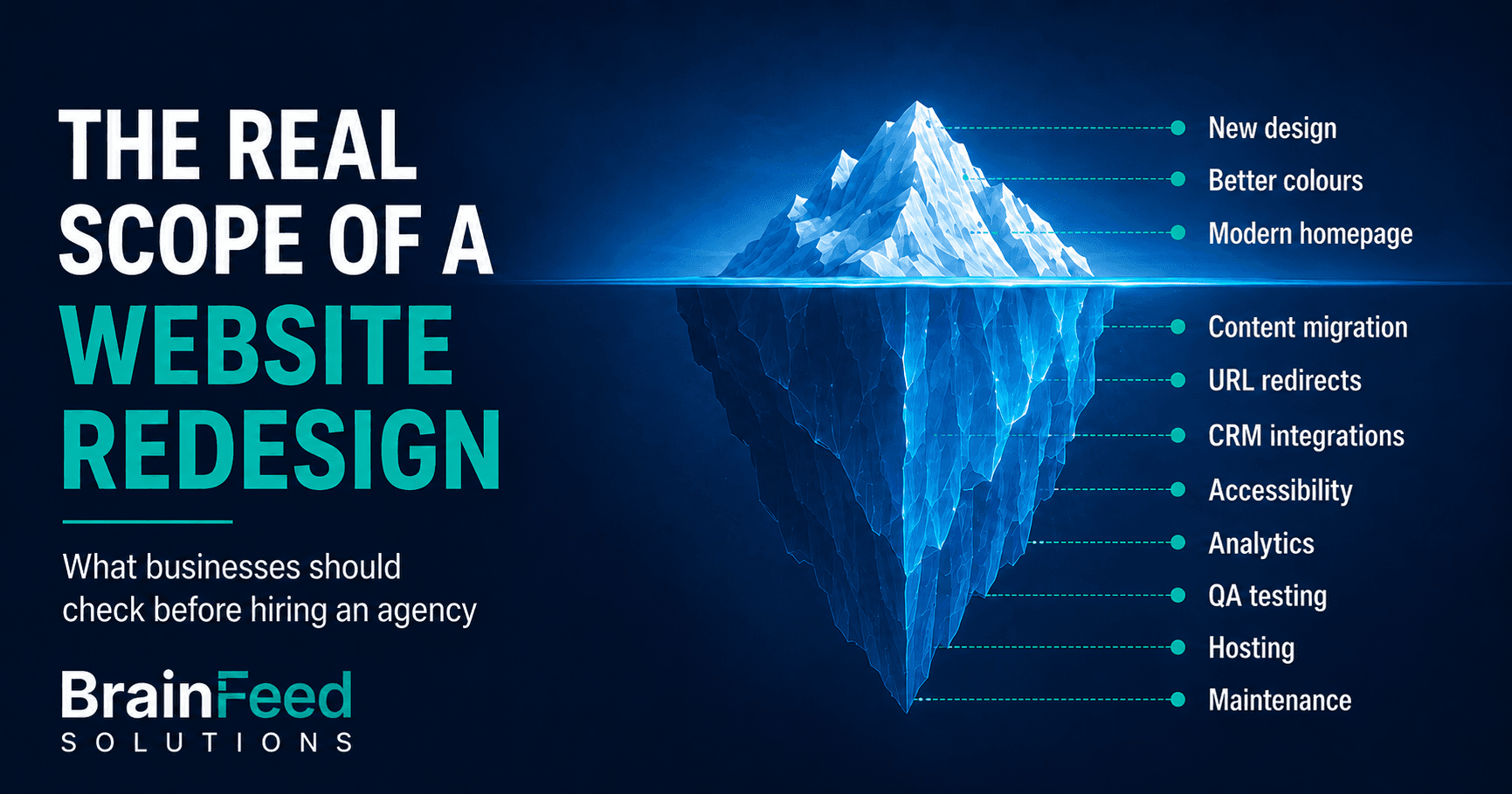
Here's a pattern we've seen play out more than once. A professional services firm requests redesign proposals from three agencies. Two quote £8,000-£12,000. One quotes £22,000. All three "include the full website."
The firm picks the £9,500 quote. Six weeks in, they hit a wall: the agency hasn't accounted for migrating 400 blog posts, building a CRM integration with HubSpot, or creating 301 redirects for the 80 URLs that are changing. Each one lands in a separate change order. The final invoice runs well past the original number - plus months of timeline slip.
The problem started with the proposal. "Full website redesign" meant different things to each party, and both sides accepted the ambiguity before signing.
This guide is about closing that gap before you issue an RFP - how to read what a redesign service actually includes, what usually falls outside it, and the questions that tell you whether an agency can deliver.
Refresh, Redesign, or Rebuild?
Before you compare providers, get clear on which job you're actually buying. The three terms get used interchangeably, and they carry very different costs.
A refresh updates the surface - typography, colour, imagery, page styling - while leaving the structure, content, and technology largely intact. Fastest and cheapest.
A redesign rethinks the user journey, navigation, page templates, messaging, and conversion paths. It often keeps the existing CMS but changes almost everything the visitor sees and does.
A rebuild (or replatform) changes the underlying technology - the CMS, integrations, or hosting architecture. This is the most technically involved, and where migration risk lives.
Agencies sometimes use all three words for the same proposal. Ask which one you're actually being quoted for. The rest of this guide assumes a redesign, which is where scope disputes cluster.
What Website Redesign Services Typically Include
A scoped redesign engagement - from a reputable agency - generally covers:
Discovery and audit. A sitemap review, analytics walkthrough, and heuristic evaluation of the current site. For a typical small or mid-sized redesign this runs one to two weeks. The exact duration matters less than whether the agency audits the current site, defines the business problem, and documents the scope before anyone opens a design tool.
Information architecture. Restructuring the navigation, page hierarchy, and URL structure. This is where scope starts to blur - the IA may or may not include writing the new copy to fill the restructured pages.
Design (templates, not every page). Agencies design templates, not every individual page. A 120-page site might have 8-10 templates: Homepage, Service, About, Blog listing, Blog post, Contact, FAQ, Landing page. If your redesign quote doesn't specify the number of templates, ask.
Development. Building the design on a CMS - WordPress, Webflow, a headless stack, or something custom. The platform you land on drives your long-term cost more than the build fee does, so ask the agency to separate development from what comes after it: hosting, platform subscriptions, paid plugins or licences, and ongoing maintenance. A low-cost self-managed WordPress install and a managed SaaS platform can carry very different ownership burdens, even when both show up under the same "development" line.
Content migration. Moving your existing copy, images, and documents from the old site to the new one. Note the word existing. Agencies migrate what you have. If it needs updating or doesn't exist yet, that's content creation - a different service.
QA and launch. Cross-browser and cross-device testing, staging review, go-live support. Most agencies include this, but the support period varies: some offer a defined post-launch warranty, others barely mention it. Confirm what's covered and for how long.
Five Things That Fall Outside the Standard Scope
This is where most disputes live.
1. New content creation.
Content migration and content creation are usually separate scope lines. If you're restructuring from 50 service pages to 12 and need fresh copy for the consolidated pages, make sure copywriting is explicitly included. A content audit before signing - knowing exactly which pages need new writing - prevents this from turning into a mid-project crisis.
Copy doesn't always have to exist on day one; it usually follows approved positioning and wireframes. But if your team won't supply approved copy to the project's content milestones, put copywriting, editing, stakeholder review, and content entry in the scope as explicit deliverables. Don't leave "content supplied by client" undefined - that's a content and branding workstream, and it needs an owner and a deadline.
2. Third-party integrations.
Every integration beyond basic contact forms adds development time: CRM (HubSpot, Salesforce), live chat, booking systems, customer portals, e-commerce modules. We've seen a single Salesforce integration add several thousand dollars in change orders because the CRM connection wasn't in the original scope. Itemize every tool your site needs to talk to before signing.
3. SEO transition and 301 redirect mapping.
When URLs change during a redesign, 301 redirects tell search engines where the old pages moved - Google's own guidance is to use permanent redirects and monitor the move in Search Console. Get this wrong and you lose whatever ranking equity those pages held. A site with meaningful search visibility can drop sharply after launch when old URLs are removed without relevant redirects, metadata is lost, internal links break, or the new site can't be crawled properly.
A proper SEO transition plan covers more than redirects: an inventory of current indexable URLs, one-to-one redirect mapping where relevant, metadata and canonical migration, internal-link updates, a fresh XML sitemap, staging checks, launch-day verification, and post-launch monitoring in Search Console. Ask which of these are in scope before you sign.
4. Post-launch bug fixes and support.
Many agencies include a defined post-launch support window, but the length and coverage vary widely. Confirm what counts as a defect, how long the support window lasts, and whether later work is billed hourly, through a retainer, or under a separate maintenance agreement. If you expect ongoing changes (campaign landing pages, new service pages, feature updates), ask about a retainer before the project starts. The day after launch is a bad time to negotiate one.
5. Ongoing hosting, performance monitoring, and maintenance.
Hosting is usually not included. Neither is monitoring uptime, performance, or plugin and dependency updates. If you're on WordPress, unmanaged plugin updates can break a site silently - we've seen a contact form sit broken for weeks because a plugin conflict from an auto-update went undetected.
Scope this explicitly. Either the agency runs ongoing support and maintenance, or someone internal owns it. There's no safe "we'll figure it out."
How to Evaluate Agencies: The Questions That Expose Capability
A portfolio tells you what a site looks like. It tells you nothing about whether the project was delivered on time, on budget, or without drama. Ask process questions instead.
"Walk me through what happens at kickoff - specifically, what brief do you send us?"
A mature agency sends a structured brief template: page inventory, content responsibility matrix, integration list, redirect requirements, staging environment URL, QA checklist. If the answer is "we get on a call and discuss the vision," that's a warning sign - not because vision is bad, but because lack of structure is what creates change orders.
"What CMS do you build on, and why is that right for our use case?"
The right answer names a platform and explains the tradeoff. "We build on WordPress because it gives you editorial flexibility and you already have internal people who know it" is a real answer. "We work with whatever the client wants" is a non-answer - it usually means they have a preference they're not disclosing.
"How do you handle 301 redirects when we change URL structure?"
If they look slightly confused, that's meaningful information. The question isn't exotic. Any agency that has done a redesign for a site with existing search traffic knows this comes up every time. The answer should describe a specific process: URL audit, mapping spreadsheet, staging QA, launch-day verification.
"Who owns QA - your team or mine?"
"Joint" is the honest answer, but you want to know what the agency actually delivers vs. what they expect you to review. Some agencies hand over a staging link and call it QA. Better ones send a signed-off checklist covering every page, every form, every browser, every breakpoint.
"What does support look like at 90 days post-launch?"
This separates agencies who think past launch from those who don't. A good answer describes a specific tier: what's included, what's billable, and how to raise a ticket. "We're always here for you" is not a support policy.
What to Look For in a Proposal
A proposal that protects you names things you can count. At minimum, it should specify:
- Page template count, not "the full website"
- Content responsibilities - who writes what, in what format, by when
- Integration list - every third-party tool named, with scope (read-only, write, or bidirectional)
- Revision rounds - how many, at which stages, what qualifies as a revision
- SEO transition plan - redirect strategy, metadata and canonical migration, sitemap, post-launch monitoring
- Analytics and tracking migration - GA4, Tag Manager, ad pixels, and conversion tracking carried across
- Accessibility target - which standard, and who tests against it
- Browser and device support - the matrix you'll be signed off against
- Performance acceptance criteria - agreed metrics, testing tools, test conditions, target pages, and responsibility for third-party scripts and content
- Ownership and licensing - who owns the design files and custom code, which third-party assets remain licensed, and whose accounts hold the domain, hosting, analytics, and platform access
- Launch safeguards - content freeze date, migration cut-off, and a backup/rollback plan
- Post-launch support terms - duration, what's included, what's hourly
- Hosting recommendation - platform, cost, who manages it
If any of these are missing, ask for them in writing before you sign. A good agency won't push back on specificity - they prefer it too, because scope ambiguity hurts their margin as much as yours.
You can use the same evaluation lens when comparing bids more broadly - our guide to finding a cost-effective web development agency walks through how to read quotes side by side when the scope descriptions don't match.
Score the Proposals Side by Side
When you've got three proposals that all say "full redesign," a simple weighted scorecard turns a vague comparison into a decision. Rate each agency out of 10 on the criteria that actually predict a clean delivery, then weight the scores:
| Criterion | Weight |
|---|---|
| Discovery and business understanding | 15% |
| Information architecture and UX | 15% |
| SEO and migration planning | 15% |
| Technology and integrations | 15% |
| Content responsibilities | 10% |
| QA, accessibility, and performance | 10% |
| Project governance and communication | 10% |
| Training and post-launch support | 10% |
The agency with the prettiest portfolio rarely wins this table. The one that scoped discovery, migration, and governance seriously usually does - and that's the one most likely to stay close to the agreed scope, budget, and timeline.
Red Flags That Predict a Bad Engagement
No discovery phase. Jumping straight to wireframes without understanding why the current site underperforms means designing a solution to an undiagnosed problem.
"Unlimited revisions." Treat this one cautiously - it usually has a boundary you'll find later. Ask which stages it applies to, whether structural changes count, and what happens when an already-approved direction gets reopened. That's where "unlimited" quietly ends.
No mention of content strategy. A redesign that only changes how the site looks - not what it says - solves half the problem. Plenty of B2B sites convert poorly because the messaging is unclear, not because the design is dated.
Vague deliverables. "Complete website redesign including all pages" is commercially meaningless. Every deliverable in a contract scope should refer to something countable or measurable.
No CMS training or handoff. For a normal marketing site, your team should be able to make routine content edits without going back to the agency for every change. Confirm what's editable, what needs development support, and whether training and documentation are included.
What Good Looks Like
The agencies worth hiring lead with discovery, lock scope before design, name every deliverable in the proposal, and treat the redirect plan as table stakes - not an add-on.
At BrainFeed, our web design and development services begin with a one-to-two-week discovery phase: current site performance (Core Web Vitals, analytics, crawl issues), sitemap and content review, integration requirements, and a written scope every stakeholder signs before design starts. The proposal names the page templates, the technical requirements, and who owns which deliverable - so nothing surfaces as a surprise halfway through.
Performance optimisation, SEO foundations, analytics setup, launch support, and training are part of that process, not line items that appear once the build is underway. And when the site's live, ongoing monitoring, security, and improvement continue as a separate, defined engagement - not an afterthought.
If you're evaluating agencies for an upcoming redesign, that page covers how we scope and deliver - and what a discovery-first engagement looks like in practice.
The right agency for your redesign isn't the one with the best-looking portfolio. It's the one that asks the most specific questions before they quote.