Media & Publishing Venture
An AI-assisted content + programmatic-SEO engine for a trade-show news, directory and reviews property — built and operated end-to-end.
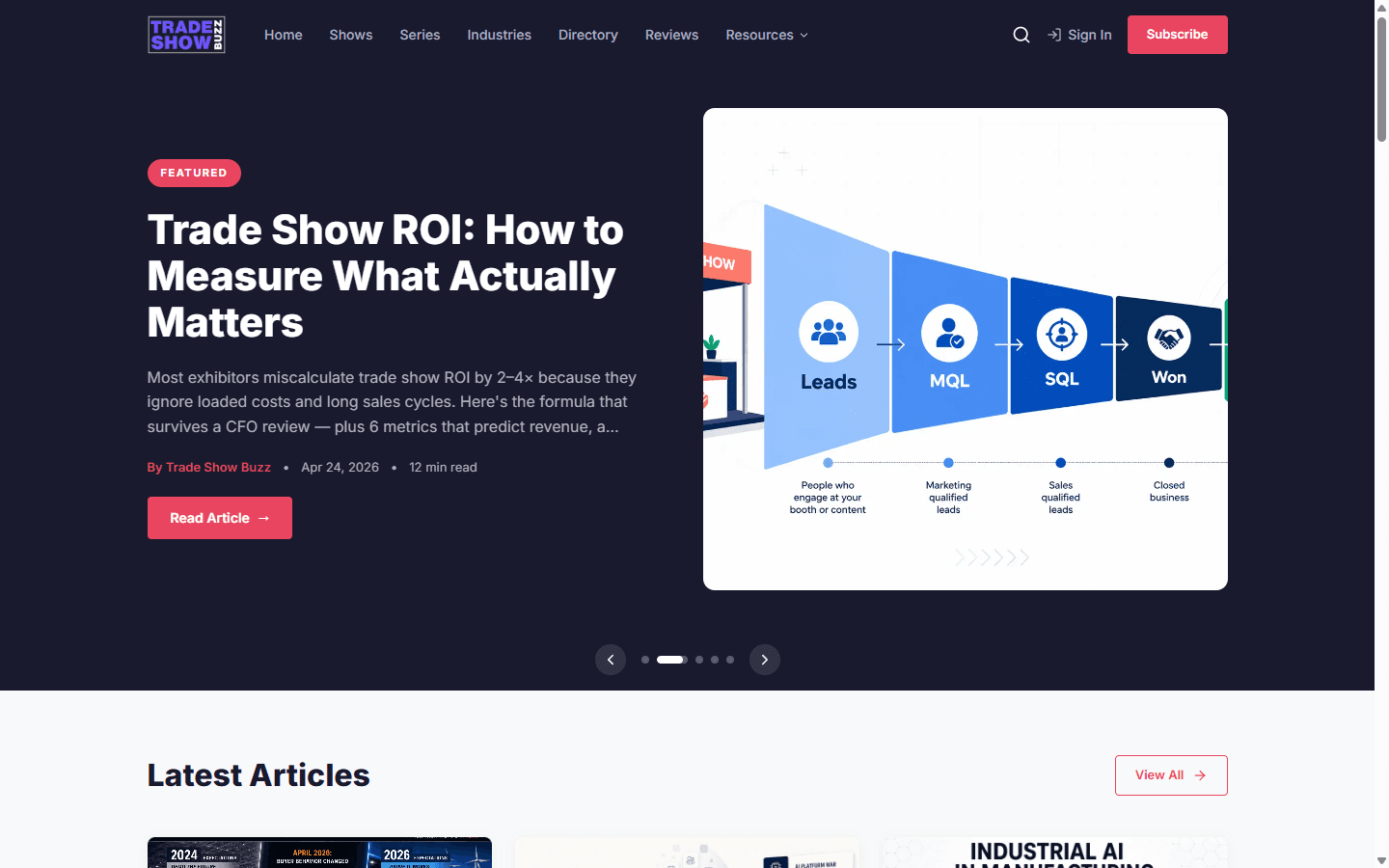
TradeShowBuzz is a content and SEO engine for the trade-show industry. We publish a weekly editorial cadence on event ROI, exhibitor strategy, and buyer behaviour, while a programmatic /shows directory keeps every major event indexed and trending. Editorial and directory work together as a single SEO surface — neither runs as a side bet.
The system covers two different search intents in parallel: transactional queries ("Hannover Messe 2026 dates and exhibitors") via the programmatic /shows pages, and research queries ("how to measure trade-show ROI") via deep editorial. Each content shape compounds the other — internal links from articles strengthen directory pages, and the directory's structured metadata feeds editorial themes.
A distribution loop ships three LinkedIn posts per published article on a dual-track founder + company profile, so reach compounds in the same week the SEO blog goes live — not in a separate quarter when distribution finally gets its turn.
Trade-show news on the web is fragmented. Most directory sites are crawler-only with no editorial voice. Most editorial sites don't have systematic coverage of events. We saw room for one property that did both — and a chance to build the AI-assisted production model we wanted to use on client retainers.
Three different content problems run in parallel here. Volume without losing depth: 2,500+ word, properly-researched pieces on a weekly cadence, without burning out a writer or descending into AI slop. Two SEO intents, each needing a different content shape. And authority that has to compound — editorial, directory, distribution, and backlinks each work on their own, but the flywheel only spins if they reinforce each other.
Most content sites cut one of those corners. They produce editorial without programmatic directory pages, or ship articles without a distribution plan, or auto-publish AI drafts without quality gates. Each shortcut caps the ceiling. We wanted to build the thing that didn't cut any of those corners — and use it to refine the production model we now bring to client work.
Each major event gets a structured page backed by a DB record. A scraper keeps show metadata fresh; a buzz-score surfaces trending events.
A nine-step blog workflow with named agents. Webby drafts under brief; Soniya QA-reviews. Every piece runs through the same gates.
Three-post pack per article on dual-track founder + company profiles. Distribution ships in the same week as the article, not next quarter.
The weekly editorial cadence is live and every piece runs through the nine-step workflow by default. The /shows directory covers major events with auto-refreshing metadata, and the buzz-score surfaces trending events without manual curation.
Dual-pillar organic moat in place — programmatic /shows pages targeting transactional intent and editorial themed series targeting research intent, running in parallel rather than one waiting on the other.
Distribution loop closed: three-post LinkedIn pack per article on a dual-track founder + company profile, shipped in the same week as the SEO blog rather than as a separate quarter's work.
With the engine running on a clean baseline, we're now tracking Search Console impressions, indexed-page counts, organic traffic by intent (/shows/* vs /articles/*), referring-domain growth, and LinkedIn impressions. A 'by the numbers' update will fold into this page at the 90-day mark.
Building TradeShowBuzz taught us how to run a content + SEO engine at scale with a small team. The nine-step blog workflow, the named-agent production model, the dual-pillar SEO strategy, the same-week distribution loop — they're now part of how we approach client retainers. We don't just talk about AI-assisted delivery; we operate it. When a client asks how we'd scale their content program, we point them here.
Book a free 30-min consultation. We'll talk about what you're building and whether we can help.
